Walk into any legal dispensary and you'll see potency numbers plastered everywhere. 28% THC flower. 85% distillate cartridges. 1000mg edibles. Most of those percentages are marketing theatre, carefully chosen test samples or creative math with total cannabinoids. But THC diamonds,those glittering crystalline chunks that look like broken glass in a jar,are the rare exception where a 90-something percent label isn't exaggeration. These faceted formations are nearly pure THCa in solid form, the result of deliberate crystallization that isolates a single molecule from the chaotic soup of a whole-plant extract. If you've ever wondered whether ultra-high potency claims are real or just hype, diamonds are where the science backs up the swagger.
Understanding THC diamonds means grasping one critical distinction that most cannabis marketing glosses over: the difference between an isolate and a full-spectrum extract. Diamonds sit at the isolate end of that spectrum,they're what happens when extraction science prioritizes purity over the entourage effect. That doesn't make them better or worse than live resin or rosin; it makes them different, with a specific use case and experience profile. In this guide, we'll walk through what diamonds actually are in plain chemistry terms, how they're made, why the THCa-to-THC conversion matters when you heat them, and whether that 99% purity translates to a 99% better high. No hype, no hand-waving,just the honest breakdown of cannabis's most visually striking concentrate.
The Isolate vs Extract Distinction: Why Diamonds Are Different
Every cannabis concentrate exists on a spectrum from whole-plant complexity to single-molecule purity. On one end, you have live resin and rosin,thick, terpy extracts that preserve dozens of cannabinoids and aromatic compounds from the original flower. These products chase the entourage effect, the theory that cannabis compounds work better together than in isolation. On the opposite end, you have isolates: refined substances that strip away everything except one target molecule. THC diamonds (technically THCa diamonds) are crystalline isolates,they're what remains after every other compound has been methodically removed.
This matters because purity and potency are not the same thing as effect quality. A diamond might test at 99.9% pure THCa, but that doesn't automatically make it nine times better than 90% live resin. The diamond delivers a clean, intense, one-note cannabinoid hit. The live resin delivers a complex blend that might feel more rounded, more flavourful, or more embodied depending on your brain chemistry and what you're looking for. Neither is superior,they're tools for different jobs.
What Makes a Diamond a Diamond
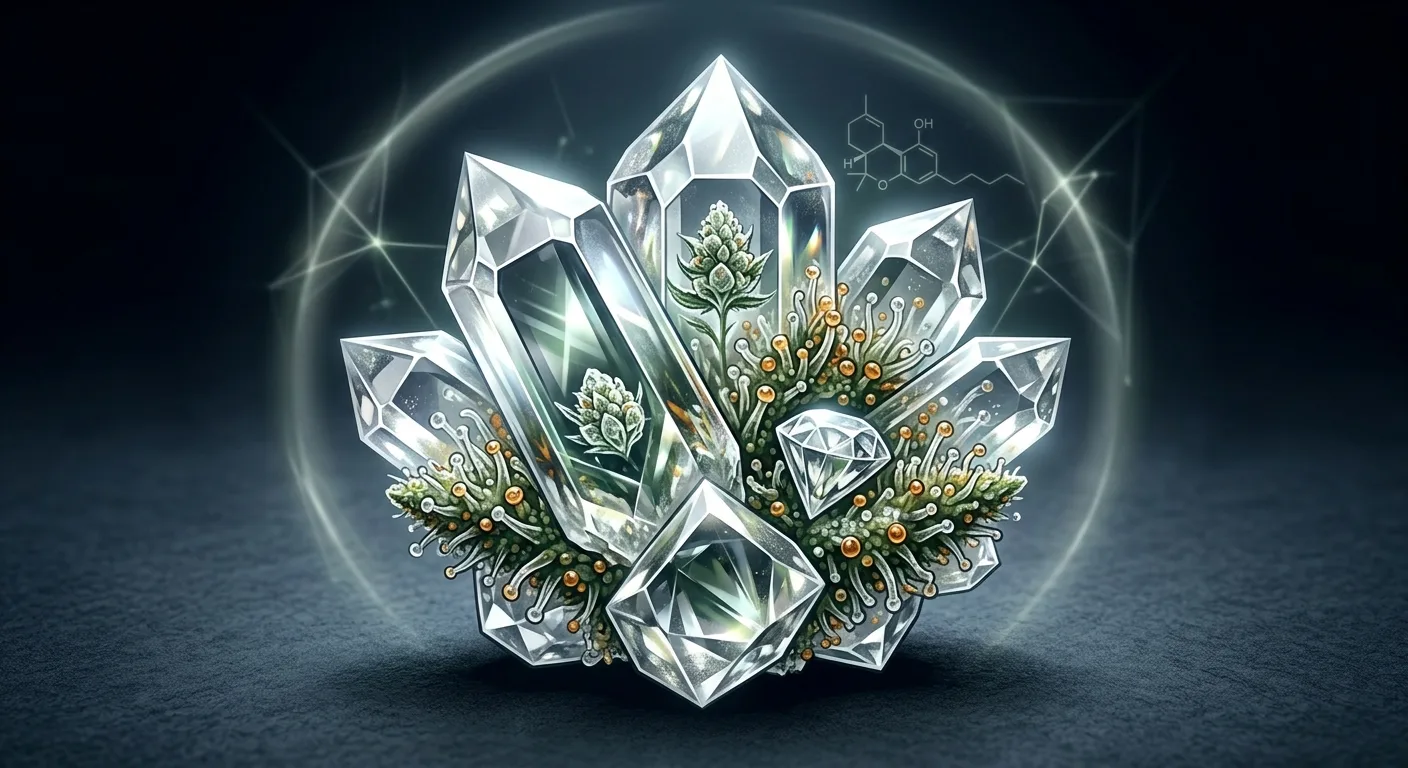
The term "diamond" is borrowed from gemology because the crystals genuinely resemble quartz or broken glass,clear to slightly cloudy formations with defined edges and facets. They form through a process called THCa crystallization, which exploits the fact that THCa molecules (the acidic precursor to THC) can arrange themselves into a repeating lattice structure under the right conditions. Think of it like rock candy forming in a sugar solution, except the "sugar" is a cannabinoid and the solution is a cannabis extract.
Most diamonds sold in Canada come suspended in a small amount of terp sauce,the liquid terpene-rich extract left over after crystallization. This pairing (often labelled "diamonds and sauce") gives you the best of both worlds: the clean THCa punch of the crystal plus the flavour and supporting cannabinoids from the sauce. Some products separate them entirely, offering pure diamonds alone, but the combo format is more common because it's easier to handle and tastier to consume.
Why 99% Is Legitimate Here (and Only Here)
When you see a 99% THC claim on flower or even most vape cartridges, it's either a lie, a typo, or a wildly optimistic reading of a cherry-picked lab test. Cannabis flower tops out around 35% total THC in even the most potent strains, and distillate cartridges reliably hit 80-90% but rarely push past 95% due to residual plant lipids and minor cannabinoids. Diamonds are the exception because they're not a mixed extract,they're a purified compound that has been crystallized into solid form. When a reputable producer submits a diamond sample for COA testing, a 97-99% THCa result is both common and honest.
That percentage reflects purity, not total effect. It tells you that nearly every molecule in the crystal is THCa. It does not tell you how that diamond will compare experientially to an 85% live resin cart or a 28% joint, because those products contain different compound profiles that interact with your endocannabinoid system in different ways. For more on reading and interpreting cannabinoid lab reports accurately, see our detailed guide on how cannabis lab testing works and reading a COA line by line.
How THCa Diamonds Are Made: Crystallization in Plain English
The science behind diamond formation sounds intimidating,words like "supersaturation" and "nucleation" get thrown around,but the core concept is simple: slow separation under controlled conditions. Producers start with a high-quality cannabis extract (often live resin or another hydrocarbon-based pull that preserves cannabinoid acids). That extract is placed in a sealed container and stored at carefully managed temperature and pressure, allowing THCa molecules to gradually fall out of solution and stack into crystal structures over days or weeks.
There are two main production methods: closed-loop crystallization (where the extract remains under pressure in a sealed jar, sometimes called "diamond mining") and chromatography-based isolation (where the extract is run through columns to separate THCa from other compounds before crystallization). The closed-loop method is more common in the Canadian market because it's less equipment-intensive and produces the diamonds-and-sauce format that consumers recognize. Chromatography yields purer isolate but requires expensive lab equipment and extra refinement steps.
The Role of Pressure and Time
Crystallization isn't instant. Left alone in a jar, cannabis extract will naturally begin to "crash out" THCa crystals over time as the solution becomes supersaturated,meaning it holds more dissolved THCa than it can stably contain. Producers accelerate and control this process by adjusting temperature (often cycling between cool and slightly warm) and maintaining pressure (which keeps volatile terpenes in liquid form rather than evaporating). The longer and slower the process, the larger and more defined the crystals grow. Rushed crystallization produces smaller, sandier formations sometimes called "sugar" instead of true diamonds.
Some producers add a seed crystal,a tiny pre-formed THCa crystal,to the extract to give the molecules a nucleation point to latch onto, similar to how a string in sugar water helps rock candy form faster. This technique improves yield and consistency but isn't strictly necessary if the extract is pure and patient enough.
What Happens to the Terpenes
As THCa crystallizes into solid form, it leaves behind a liquid layer rich in terpenes and minor cannabinoids,the terp sauce. This sauce is not a byproduct or waste; it's a valuable co-product that many consumers prefer to use alongside the diamonds. Some extractors siphon off the sauce and sell it separately. Others leave it pooled around the crystals in the jar, creating the classic diamonds-and-sauce presentation. A few producers even reintroduce specific terpene blends to the diamonds after crystallization to fine-tune flavour profiles.
The sauce typically retains whatever flavour and aroma the original strain carried, which is why diamonds-and-sauce combos from live resin extracts taste dramatically better than isolated diamonds alone. For a deep dive into how terpenes shape cannabis flavour and effect, check out our article on what terpenes are in weed and the aroma science behind your favourite strains.
THCa to THC: Why You Need Heat and What Actually Converts
Here's the part that confuses new diamond users: THCa does not get you high. If you ate a raw diamond crystal like a sugar cube, you'd feel nothing beyond maybe a mild stomach ache. THCa is the acidic precursor molecule that exists in living and freshly harvested cannabis. It only becomes psychoactive THC through decarboxylation,a heat-driven chemical reaction that removes a carboxyl group (COOH) from the molecule and converts it into the neutral, brain-crossing form.
When you dab, vape, or smoke a diamond, you're applying enough heat (typically 300-450°C at the nail or coil surface) to instantly decarboxylate the THCa into THC as it vapourizes. That's why the effect is immediate and intense despite the starting material being "inactive" THCa. The conversion happens in real-time, second by second, as the crystal melts and boils. For most consumption methods, this conversion is near-total,very little unconverted THCa makes it into your lungs or bloodstream.
Decarb Efficiency and Consumption Methods
Not all heat applications decarboxylate with equal efficiency. Dabbing at proper low-temp ranges (around 315-400°C) converts THCa thoroughly while preserving some terpene vapour for flavour. High-temp dabs (500°C+) convert everything but burn off terpenes and risk creating harsh, degraded vapour. Vape cartridges loaded with diamond-infused distillate run cooler (200-250°C) but still convert effectively because the contact time is longer.
Some users try adding diamonds to joints or bowls, sprinkling crushed crystals over flower. This works but wastes potency,combustion temperatures are inconsistent and much of the THCa burns rather than vapourizing cleanly. If you want to use diamonds in flower, a dry-herb vapourizer set to 185-205°C will decarb them more efficiently than open flame. For a complete breakdown of the decarboxylation process and how it applies to different products, read our guide on decarboxylation explained and the essential heat activation that makes cannabis edibles work.
Does 99% THCa = 99% THC After Heating?
Technically, no. The decarboxylation reaction removes about 12% of the molecule's mass (the carboxyl group that gets released as CO₂). So a 99% pure THCa crystal becomes roughly 87% THC by weight after full conversion. In practice, this molecular accounting is splitting hairs,the experience of vapourizing a 99% THCa diamond is as close to pure THC as most consumers will ever encounter. The remaining 1% consists of trace cannabinoids, leftover terpenes from the sauce, or residual plant lipids depending on extraction quality.
The Experience: What a 99% THC Hit Actually Feels Like
Potency percentages mean little without context. A 99% pure THCa diamond delivers a clean, cerebral, fast-onset high that peaks quickly and tapers within 1-3 hours. Users describe it as laser-focused, sometimes uncomfortably intense if the dose is misjudged. There's minimal body load, little to no couch-lock (unless paired with a heavy indica terp sauce), and almost no flavour if consumed as an isolate. It's THC in its most stripped-down, unfiltered form,which is either exactly what you want or disappointingly one-dimensional depending on your preferences.
Compared to smoking flower or hitting a live resin cart, diamonds feel sharper and shorter. The high climbs steeply within minutes and plateaus at a level that can surprise even experienced users. Because there are no supporting cannabinoids like CBD, CBG, or CBN, and minimal terpenes if you're using pure isolate, there's no "cushion" to soften the THC impact. This is ideal for tolerance-hardened consumers chasing efficiency or medical users who need precise, high-dose cannabinoid delivery without plant matter. It's less ideal for casual users, flavour chasers, or anyone prone to THC-induced anxiety.
Tolerance and Dose Creep
One practical concern with regular diamond use is tolerance acceleration. Because diamonds deliver near-pure THC in concentrated doses, your endocannabinoid system adapts quickly. Users report needing larger dabs or more frequent sessions to maintain the same effect within weeks of switching from flower or live resin to diamonds. This isn't unique to diamonds,all high-potency concentrates carry this risk,but the isolate format seems to drive tolerance faster than full-spectrum extracts, possibly because the lack of minor cannabinoids means your CB1 receptors get hammered by THC alone without modulation.
If you notice diminishing returns, consider rotating between product types (flower, live resin, diamonds) rather than using isolates exclusively. For strategies on managing tolerance build-up and planning effective resets, see our honest guide on tolerance breaks, timelines, taper options and the balanced-product path that actually works.
Diamonds and Sauce vs Other Concentrates: Where They Fit
The concentrate market offers a dizzying array of formats,shatter, budder, live resin, rosin, distillate, isolate,and diamonds occupy a specific niche. They're not a replacement for every other concentrate; they're a high-potency, low-flavour option for users who prioritize cannabinoid punch over terpene complexity. Here's how they compare to the most common alternatives.
Diamonds vs Live Resin
Live resin is extracted from fresh-frozen cannabis and retains a full spectrum of cannabinoids and terpenes, usually testing between 70-90% total cannabinoids with 5-15% terpenes. It tastes like the living plant, smells loud, and delivers a well-rounded high. Diamonds (especially when isolated from their sauce) test higher in pure THCa but sacrifice flavour and supporting compounds. If you value flavour and entourage effect, choose live resin. If you value potency and dose efficiency, choose diamonds. Many users buy diamonds-and-sauce specifically to split the difference, getting crystal potency with live-resin-level terpenes in the sauce.
Diamonds vs Shatter or Budder
Shatter and budder are texture-defined concentrates made through various extraction and post-processing techniques. They typically test 80-90% total cannabinoids and include a broader cannabinoid profile than diamonds. Shatter is stable and easy to handle; budder is whipped and easier to scoop. Both offer more flavour than isolated diamonds but less than live resin. Diamonds are more potent but less versatile,you can't easily mix them into joints or spread them on paper like you can with budder. For more on concentrate textures and usage, see our comparison of shatter vs wax vs live resin and how cannabis concentrates compare.
Diamonds vs Distillate
Distillate is refined, decarboxylated THC in liquid form, usually found in vape cartridges. It tests similarly high (85-95% THC) but has zero flavour or aroma because the distillation process strips out all terpenes. Producers add artificial or cannabis-derived terps back in for taste. Diamonds, by contrast, are THCa in crystalline form, undecarboxylated until you heat them, and often paired with natural terp sauce. Distillate is convenient and discreet; diamonds are a dabbing-focused format for home use. Neither offers the entourage effect, but diamonds paired with sauce come closer.
Buying and Using Diamonds: Practical Considerations
THC diamonds are widely available at licenced Canadian dispensaries and online cannabis retailers, but not all diamonds are created equal. Quality varies based on starting material, extraction skill, and how the product is stored and handled. Here's what to look for and how to use them without waste or disappointment.
What to Look For When Buying
Check the Certificate of Analysis (COA) if available. A legitimate diamond product should show 90%+ THCa purity, minimal residual solvents (under 500 ppm for hydrocarbons), and pass microbial and heavy metal testing. The crystals should be translucent or slightly cloudy, not opaque or discoloured. Dark amber or brownish crystals suggest oxidation or low-grade starting material. If the product is diamonds-and-sauce, the sauce should be aromatic,if it smells like nothing, the terpenes have evaporated or were never present.
Packaging matters too. Diamonds are best stored in airtight glass jars kept cool and dark. Exposure to air, light, and heat degrades both the crystals and the terp sauce over time. Avoid products in plastic containers or anything that's been sitting on a shelf under bright dispensary lights for months.
Consumption Methods That Work
The gold standard for diamonds is low-temp dabbing. Use an e-nail or torch-heated banger, let it cool to 315-370°C (use an infrared thermometer if you're serious), drop a small diamond or chip of diamond into the banger, cap it, and inhale slowly. This vapourizes the THCa cleanly without scorching terpenes. You can also use a concentrate pen or wax vapourizer with a ceramic or quartz coil,just load a tiny piece, pulse the heat, and draw gently.
Some users mix crushed diamonds into terp sauce or live resin to boost potency while retaining flavour. This is called "spiking" your dab, and it's an easy way to dial in your ideal THC-to-terpene ratio. Another option is adding diamonds to edible infusions, though you'll need to decarboxylate them first by baking at 110-120°C for 30-40 minutes, then infusing into fat. For step-by-step infusion techniques, check our guide on how to make cannabutter using the complete Canadian home infusion method.
Dosing: Start Stupidly Small
A rice-grain-sized piece of diamond is a reasonable starting dose for someone with moderate concentrate experience. That's roughly 10-20mg of THCa, which converts to 9-18mg of active THC. If you're coming from flower, that's equivalent to a half-gram joint of 25% bud,but it hits you in one breath, not ten minutes of smoking. Go smaller if you're new to concentrates. Go bigger if your tolerance laughs at 100mg edibles. The point is: diamonds don't look like much, but a little goes a long way, and the margin for error is slim.
Yes, by weight. THC diamonds are 95-99% pure THCa, which converts to roughly 85-87% active THC when heated. Regular cannabis flower maxes out around 30-35% total THC. However, strength isn't the same as better,diamonds deliver isolated THC without the supporting cannabinoids and terpenes that shape flower's effects.
Not effectively. THCa (the compound in raw diamonds) is non-psychoactive. You need to heat diamonds through smoking, vaping, or dabbing to decarboxylate the THCa into active THC. If you want to ingest diamonds, you must decarb them in an oven first (110-120°C for 30-40 minutes) before mixing into edibles or tinctures.
When stored properly in an airtight glass container in a cool, dark place, diamonds remain stable for 6-12 months. The crystals themselves degrade slowly, but the terp sauce they're often packaged with loses aroma and flavour faster,usually within 3-6 months. Exposure to air, light, and heat accelerates degradation significantly.
They're essentially the same thing,both are THCa crystals that have been isolated through extraction. 'Diamonds' usually refers to larger faceted formations sold with terp sauce, while 'crystalline' or 'isolate' often describes powdery or smaller crystals sold alone. The purity and potency are comparable; the difference is mostly presentation and whether terpenes are included.
Cloudiness can indicate minor impurities, residual plant lipids, or incomplete crystallization,but it doesn't necessarily mean the product is low-quality. Some strains and extraction methods naturally produce slightly opaque crystals. However, if diamonds are dark amber, brown, or have an off smell, that's a red flag for oxidation or poor starting material.
Not in a standard 510 thread cartridge,diamonds are solid crystals that won't wick through cartridge coils. However, you can use them in a wax pen, concentrate vapourizer, or dab pen designed for solid extracts. Some users also crush diamonds and mix them into distillate to load into refillable cartridges, though this is more work than it's worth for most people.
Conclusion: The One Product Where the Potency Label Tells the Truth
THC diamonds represent the far edge of cannabis refinement,the point where extraction science isolates a single molecule and turns it into something that looks more like a mineral than a plant product. They're proof that 99% potency claims can be real, not just marketing bluster, but they're also a reminder that purity and quality aren't synonyms. A diamond delivers clean, intense, isolated THC. Whether that's better than a terpene-rich live resin or a balanced full-spectrum flower experience depends entirely on what you're looking for: dose efficiency and raw cannabinoid power, or flavour complexity and the entourage effect.