If you've been chasing that first-time high or doubling your dose to feel half the effect, you're not imagining things. Cannabis tolerance is real, measurable and backed by decades of receptor science. Your CB1 receptors don't disappear, they downregulate and retreat from the cell surface when constantly stimulated by THC. The good news? The process is reversible. The better news? You have more options than the binary choice between total abstinence and business as usual.
This guide strips away the wellness myths and prohibition-era guilt. We're walking through what actually happens in your endocannabinoid system during a tolerance break, how long different reset strategies take, the taper-versus-cold-turkey decision tree and the balanced-product middle path that lets you maintain some consumption while still lowering your baseline. No medical claims. No judgment. Just the mechanisms, the timelines and the practical options Canadians are using right now.
What a Tolerance Break Actually Does to Your Cannabinoid Receptors
When people talk about "taking a T-break," they're really describing the biological process of CB1 receptor resensitization. Your brain contains millions of CB1 receptors scattered across neurons, particularly dense in regions that govern memory, coordination, pleasure and time perception. When THC floods these receptors daily, your body adapts by producing fewer receptors and moving existing ones away from the neuron surface where THC can reach them.
This isn't damage. It's homeostasis, your body's attempt to maintain equilibrium despite constant external input. The same adaptation happens with caffeine, nicotine and most psychoactive substances. Stop the input, and the system gradually returns to its pre-exposure state. Receptor density increases. Surface expression recovers. Sensitivity returns.
The timeline isn't instant. Studies on chronic cannabis users show CB1 receptor availability begins recovering within two days of abstinence, but full normalization takes longer and varies by individual factors like consumption history, body fat percentage and metabolic rate. THC is lipophilic, it hides in fat cells and releases slowly. Someone who's been smoking multiple grams of high-potency concentrates daily for years will face a different reset curve than someone who vapes a 0.5g cartridge twice a week.
Why Your Tolerance Doesn't Reset Overnight
The receptor recovery process operates on multiple timescales simultaneously. Receptor upregulation, the increase in CB1 receptor numbers, starts within 48 hours but continues for weeks. Receptor trafficking, the movement of receptors back to the cell surface where they're functional, happens faster but still requires days. Meanwhile, THC elimination from fat tissue continues for weeks in heavy users, creating a slow background release that can interfere with full resensitization.
This layered timeline explains why some people feel a difference after three days while others need three weeks. It also explains why the first session after a break feels stronger, but the second session two days later doesn't, you got the initial receptor availability boost but haven't yet cleared residual THC or fully restored receptor density.
The Realistic Timeline: What to Expect Week by Week
Tolerance break timelines circulate online ranging from "two days is enough" to "you need six months." Both extremes miss the nuance. Receptor recovery follows a curve, not a cliff. The most noticeable gains happen early, then taper off. Here's what research and user reports actually show across different break lengths.
Days 1-3: The Adjustment Window
The first 72 hours are typically the hardest for daily users, not because of physical withdrawal (cannabis doesn't produce dangerous withdrawal syndromes) but because of routine disruption and minor discomfort. Common reports include sleep disruption, vivid dreams, mild irritability and boredom. These aren't withdrawal symptoms in the clinical sense, they're the absence of a chemical crutch your brain adapted to expect.
CB1 receptors begin upregulating during this window, but you won't feel the difference yet. Residual THC is still present at functional levels. This is the zone where most people abandon short breaks, the discomfort feels disproportionate to any perceived benefit.
Days 4-7: The First Sensitivity Shift
By day four, receptor availability has measurably increased. Users who break here and resume typically report a noticeable but modest difference, sessions feel more effective, the same dose produces stronger effects, but tolerance returns quickly with resumed use. This is the minimum viable break for people who need a quick reset before an event or want to make their stash last longer on a budget.
Sleep usually normalizes by day five. Appetite may still be adjusting if you relied on cannabis for hunger stimulation. Dreams remain intense, REM rebound is real as your brain catches up on the sleep stages THC suppresses.
Days 8-14: The Functional Reset Zone
Two weeks is the sweet spot cited most often in user communities because it delivers meaningful receptor recovery without requiring extended abstinence. By day 14, CB1 density and surface expression have substantially recovered in most users. THC metabolites are largely cleared except in very heavy or high-body-fat individuals. The subjective difference is significant: strains feel distinct again, flavours are more pronounced, and lower doses produce satisfying effects.
This timeline works for moderate users who consume concentrates or edibles daily but aren't pushing multi-gram flower consumption. It's long enough to restore receptor function without requiring a lifestyle overhaul. Many Canadians treating this as a quarterly ritual report sustained tolerance management using 14-day breaks every three months.
Days 15-30: Diminishing Returns Territory
Breaks extending past two weeks do yield additional receptor recovery, but the gains per day decrease. Someone at day 30 has more complete resensitization than someone at day 14, but the difference is smaller than the gap between day 7 and day 14. For heavy concentrate users or people with years of daily consumption, the extra two weeks matter. For moderate flower users, the benefit curve flattens.
One-month breaks often deliver the most dramatic subjective resets, where the first post-break session feels nearly psychedelic in intensity. But they also demand the most willpower and lifestyle adjustment. The trade-off calculus depends entirely on your consumption pattern and goals.
Beyond 30 Days: The Extended Reset
Studies suggest CB1 receptor density reaches near-baseline levels around four weeks, with further normalization continuing slowly up to six weeks. Breaks beyond this point don't significantly increase receptor availability but do ensure complete THC elimination even in people with high body fat or extremely heavy use histories.
Extended breaks make sense for people preparing for employment drug testing, reassessing their relationship with cannabis or dealing with severe tolerance built over many years of concentrate use. They're not necessary for routine tolerance management in moderate consumers. Understanding the role of terpenes in cannabis effects can also help you appreciate the renewed sensitivity to strain differences after a longer break.
Taper vs Cold Turkey: The Decision Tree
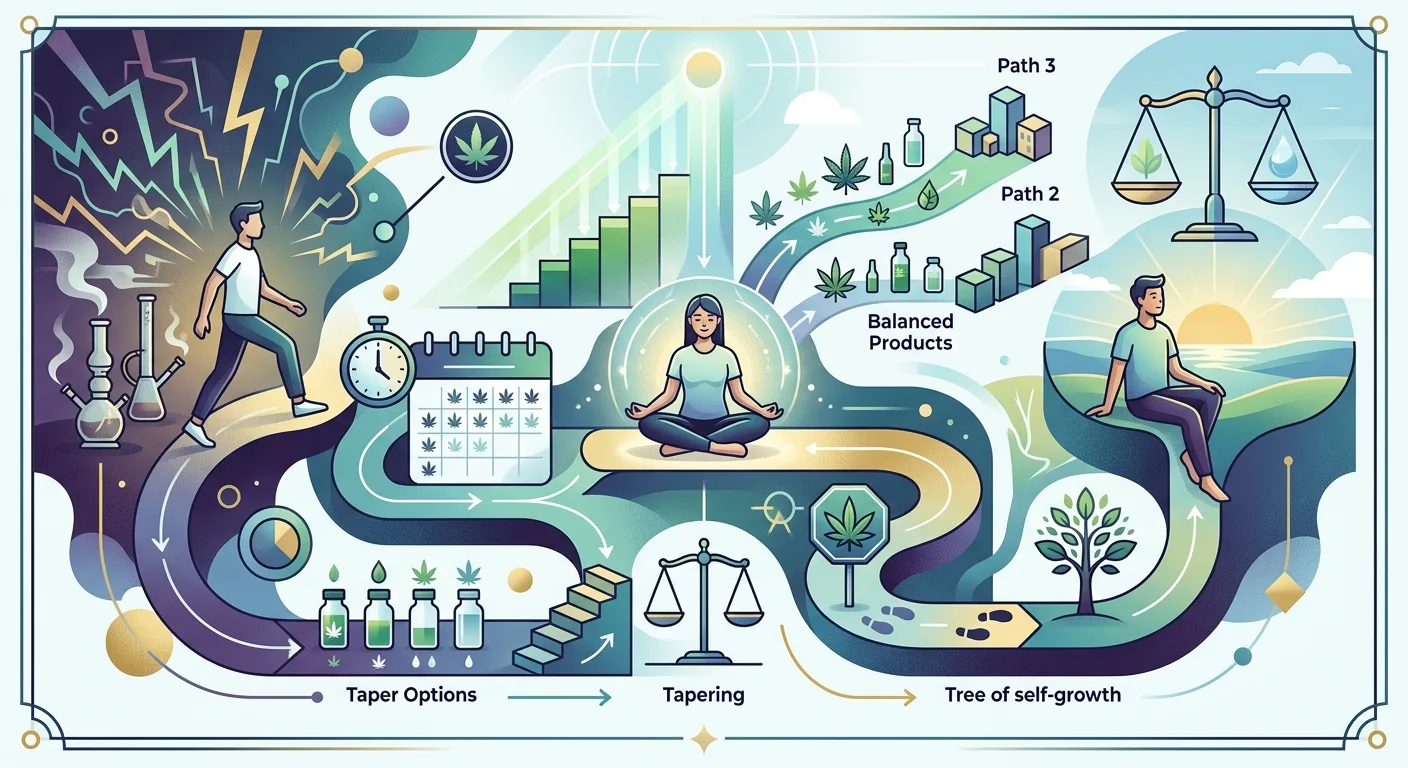
The tolerance break conversation often assumes binary abstinence, zero cannabis until the break ends. But tapering, gradually reducing consumption over days or weeks before stopping, offers a middle path that some people find more sustainable. Neither approach is superior across the board. The right choice depends on your consumption pattern, tolerance level and personal chemistry.
When Cold Turkey Makes Sense
Immediate cessation works best for people who want a clean break and don't experience significant discomfort during the adjustment period. If you're a moderate user consuming flower or low-dose edibles a few times weekly, stopping abruptly typically produces minimal disruption. Your receptor downregulation isn't severe, residual THC clears quickly and you feel the reset benefits sooner.
Cold turkey also appeals to people who struggle with moderation. If "just a little" always becomes "the whole cartridge," cutting cleanly eliminates the decision fatigue. You're either on a break or you're not, no middle ground to negotiate with yourself daily.
When Tapering Offers Advantages
Gradual reduction works better for heavy daily users, particularly those consuming concentrates or high-dose edibles who've built substantial tolerance. Tapering smooths the adjustment curve. Instead of sudden sleep disruption and irritability, you experience mild, manageable changes as you step down consumption.
A typical taper strategy: If you're currently smoking three grams daily, drop to two grams for three days, then one gram for three days, then 0.5 grams for two days before stopping. The receptor recovery process begins during the taper, so your total timeline to restored sensitivity isn't significantly longer than cold turkey despite the gradual approach.
Tapering also lets you maintain some routine and ritual, which matters psychologically for people who've built cannabis into their stress management or social habits. You're not abandoning the practice entirely, just dialing it back systematically.
The Hybrid Approach: Taper to Microdose
Some users taper down to sub-threshold microdoses and maintain that level during their break rather than stopping entirely. They're consuming too little THC to produce noticeable psychoactive effects but potentially enough to maintain some CB1 stimulation and blunt the adjustment discomfort. This approach is controversial, it likely slows receptor recovery compared to complete abstinence but may make extended breaks more sustainable for people who otherwise abandon them.
There's limited research here, but anecdotal reports suggest microdosing during a tolerance break still delivers partial resensitization. You won't reset as completely as with cold turkey, but you'll reset more than if you'd maintained your previous consumption level. For context on low-dose consumption, check out our detailed guide on microdosing THC and understanding low-dose cannabis use.
The Balanced-Product Middle Path: Using CBD and Lower-THC Options During Breaks
Total THC abstinence isn't the only path to receptor recovery. A growing number of Canadians are using balanced-ratio products during tolerance breaks, cannabis with significant CBD content and much lower THC levels than their usual consumption. This strategy works because CBD doesn't directly activate CB1 receptors the way THC does, in fact, it modulates and sometimes antagonizes them, potentially supporting the receptor reset process.
How CBD-Dominant Products Support Tolerance Breaks
CBD interacts with the endocannabinoid system differently than THC. It doesn't produce downregulation of CB1 receptors. Some research suggests CBD may actually facilitate CB1 receptor recovery by acting as a negative allosteric modulator, changing receptor shape in ways that reduce THC binding efficiency. Whether this accelerates tolerance breaks remains debated, but it clearly doesn't interfere the way continued THC consumption would.
Practically, this means you can consume CBD flower, CBD tinctures or balanced 1:1 products during a tolerance break and still achieve significant receptor resensitization, provided the THC dose stays well below your previous baseline. Someone who typically consumes 50mg THC edibles daily could switch to 5mg THC / 20mg CBD edibles during their break and still experience meaningful tolerance reduction. The ritual continues, the cannabis plant remains part of your routine, but the CB1 onslaught stops.
Choosing the Right Ratio for Your Break
The ideal CBD:THC ratio during a tolerance break depends on your goals and current tolerance. Conservative approaches use 20:1 or higher CBD-dominant products, essentially trace THC with substantial CBD. This delivers cannabis benefits like anxiety reduction and pain management without significant CB1 activation.
More moderate approaches use 4:1 or 2:1 ratios, enough THC for mild psychoactive effects but a fraction of your typical dose. This works for people who want some THC presence but primarily need to reduce their CB1 receptor load. The key is dropping your absolute THC intake by at least 75-80% from baseline.
Avoid the trap of maintaining your usual THC dose by adding CBD. A 1:1 product with 20mg THC and 20mg CBD still delivers 20mg THC. If you were previously consuming 20mg THC alone, you haven't reduced receptor stimulation, you've just added CBD to the mix. Our guide on CBD to THC ratios and understanding the cannabis spectrum breaks down how different ratios affect your experience.
Products That Support the Middle Path
CBD flower offers the full ritual of smoking or vaping without the THC load. Strains testing under 1% THC and over 15% CBD let you pack a bowl, taste terpenes and maintain your routine while giving receptors time to recover. Combining CBD flower with your favourite consumption method preserves muscle memory and sensory experience.
Balanced tinctures and capsules work for people who consume cannabis medicinally or prefer edibles. A 4:1 CBD:THC tincture lets you maintain dosing schedules for pain, anxiety or sleep support while drastically reducing THC exposure. The CBD continues delivering its therapeutic effects while your tolerance resets in the background.
Some users strategically incorporate hash during balanced-product breaks, traditional hashish often has more moderate THC levels than modern concentrates and includes a fuller cannabinoid profile. A small amount of quality hash delivers flavour and effect without the receptor saturation of dabbing live resin daily. If you're curious about this approach, our article on Afghan vs Moroccan hash styles and strength helps identify suitable options.
Maintaining Your Reset: Strategies That Actually Prevent Tolerance Creep
The hardest part of tolerance management isn't the break itself, it's maintaining lower tolerance after you resume consumption. Most people experience rapid re-tolerance if they immediately return to pre-break consumption patterns. Your receptors recovered, but they'll downregulate again quickly if you flood them with the same THC levels that necessitated the break.
The First Week Back: Go Slow
Post-break consumption requires restraint. Your first session will hit harder than you've experienced in months or years. Users consistently report needing 30-50% of their previous dose to achieve equivalent or stronger effects. Start low. One puff instead of three. Half your usual edible dose. A single dab instead of back-to-back sessions.
The temptation is to chase that intense first-session feeling by consuming heavily, but this rapidly re-establishes tolerance. CB1 receptors will downregulate in response to the renewed THC exposure. The gentler you are in week one, the longer your reset lasts. Think of it as breaking in your restored sensitivity gradually rather than immediately stressing it.
Rotation Strategies to Slow Tolerance Build
Rotating between different consumption methods and cannabinoid profiles helps maintain sensitivity longer than using the same product repeatedly. Alternate between flower, edibles and vapes rather than sticking to one format. Rotate between high-THC strains, balanced-ratio products and CBD-dominant options throughout the week. Each variation stimulates receptors differently and prevents the monotonous daily signal that drives aggressive downregulation.
Strain rotation matters more than most people realize. Different terpene profiles produce different subjective effects through the entourage effect, even at similar THC percentages. Switching between indica, sativa and hybrid strains keeps your experience varied and reduces the need to increase dosage for novelty. Learning about weed flavour profiles and cannabis taste families helps you make informed rotation choices.
Scheduled Moderation: The 5-2 and 4-3 Patterns
Some people maintain lower tolerance long-term by building regular mini-breaks into their consumption calendar. The 5-2 pattern (consume five days, abstain two days) gives receptors weekly recovery time without requiring extended breaks. The 4-3 pattern (four days on, three days off) provides even more reset time and works well for people prone to rapid tolerance build.
These patterns aren't abstinence schedules, they're tolerance management frameworks. You're still consuming cannabis most days, but the regular pauses prevent the continuous receptor saturation that causes severe tolerance. Many users report maintaining stable, modest tolerance indefinitely using scheduled moderation.
Dosage Discipline: Resisting the Creep
Tolerance often builds through gradual, unconscious dose escalation. You pack slightly larger bowls. You take one extra puff. You eat 15mg gummies instead of 10mg. Each micro-increase seems insignificant, but over weeks and months you've doubled your consumption without noticing.
Combat this by setting and logging your standard doses. Weigh your bowls. Count your puffs. Track your edible milligrams. When you notice yourself wanting more for the same effect, that's the signal to implement a mini-break or switch to balanced products for a few days rather than continuing to increase dosage.
What About the People Who Won't Stop: Harm Reduction for Continuous Use
Some people can't or won't take tolerance breaks. Medical patients managing chronic conditions, people for whom cannabis is essential mental health support, or individuals who simply don't want to disrupt their routine. Tolerance management still matters for continuous users, it just requires different strategies focused on slowing tolerance build rather than resetting it.
Lowest Effective Dose Practice
The core harm reduction principle for continuous cannabis use is always use the minimum dose that achieves your goal. Don't consume recreationally at medical doses. Don't chase ceiling effects when moderate effects suffice. Every milligram of unnecessary THC accelerates receptor downregulation.
This requires honesty about whether you're consuming to achieve a specific state or out of habit. If you can't tell the difference between your current session and not consuming, you're probably just maintaining tolerance rather than getting meaningful effects. That's the signal to either reduce your dose or take a break, even a short one.
Incorporating CBD as Tolerance Buffer
Regular CBD consumption alongside THC may slow tolerance development. The mechanism isn't fully understood, but the modulating effects of CBD on CB1 receptors appear to reduce the aggressive downregulation caused by THC alone. Users who incorporate daily CBD supplementation, either through CBD oil, capsules or balanced-ratio products, often report slower tolerance build compared to THC-only consumption.
This isn't a magic bullet. You'll still develop tolerance with continuous high-THC use, CBD just potentially slows the curve. But for medical patients who need daily cannabis and can't take breaks, adding CBD to their regimen offers a practical harm reduction strategy.
Consumption Method Variation
Continuous users benefit significantly from method rotation. Don't dab all day every day. Don't only eat edibles. Don't exclusively smoke flower. Each method produces different blood THC curves and receptor stimulation patterns. Rotating between smoking, vaping, edibles and tinctures provides variation in onset, duration and intensity that reduces monotonous receptor signaling.
Edibles produce longer-lasting but lower-peak effects compared to inhalation. Vaping allows precise dose control. Smoking delivers rapid onset but shorter duration. Strategic rotation lets you match method to need while varying the neurochemical pattern, potentially slowing tolerance compared to using one method exclusively.
Frequently Asked Questions About Tolerance Breaks
Meaningful receptor recovery begins within 48 hours, but noticeable subjective effects typically require 4-7 days minimum. The most commonly recommended timeline is 14 days, which provides substantial CB1 receptor resensitization for most moderate users. Heavy concentrate consumers may benefit from 21-30 days for more complete reset. The ideal length depends on your consumption history, tolerance level and goals.
Cannabis doesn't produce dangerous physical withdrawal like alcohol or benzodiazepines, but regular users may experience mild temporary discomfort including sleep disruption, vivid dreams, irritability and changes in appetite. These effects are typically strongest in days 1-3 and resolve within a week. They're uncomfortable but not medically concerning and indicate your body adjusting to the absence of regular THC input.
Yes. CBD doesn't activate CB1 receptors the way THC does and won't interfere with receptor resensitization. CBD-dominant flower with minimal THC content lets you maintain smoking rituals and experience cannabis terpenes while still achieving meaningful tolerance reduction. The key is ensuring the THC content is very low, ideally under 1%, rather than just adding CBD to your regular THC dose.
Rapid re-tolerance often results from immediately returning to pre-break consumption levels. Your receptors recovered during the break, but they'll downregulate quickly if you flood them with the same THC volume. To maintain lower tolerance post-break, start with 30-50% of your previous dose and increase gradually only as needed. Building in regular mini-breaks or using scheduled moderation patterns also helps prevent rapid tolerance creep.
Short breaks provide modest benefit. CB1 receptor upregulation begins within 48 hours, so even a 2-3 day break can offer a temporary sensitivity boost, particularly for light-to-moderate users. The effect is less dramatic and shorter-lasting than a two-week break, but it's not worthless. Short breaks work well as tolerance management tools between longer breaks or for people who want to stretch their stash further on a budget.
Switching strains provides variety through different terpene profiles but doesn't significantly reduce THC-driven tolerance. All high-THC strains stimulate CB1 receptors similarly regardless of indica/sativa classification or terpene content. Strain rotation enhances the subjective experience and may reduce the psychological habituation to one specific effect profile, but it won't restore receptor sensitivity the way reducing or eliminating THC consumption does. For actual tolerance reduction, you need to lower your total THC intake.
The Bottom Line: Tolerance Management Is Personal Chemistry
Cannabis tolerance isn't a character flaw or a sign you're "doing it wrong." It's basic receptor biology, a predictable adaptation to regular consumption of any CB1 agonist. The variability lies not in whether tolerance develops but in how quickly it builds and how long breaks need to be for meaningful reset. Your metabolism, consumption history, product choices and individual receptor density all shape your tolerance curve.