You've spent good money on premium cannabis flower, and you're ready to bake it into brownies or infuse it into butter for homemade edibles. You grind up your buds, toss them into the recipe, and wait for the magic to happen. Two hours later, after eating three brownies, you feel... absolutely nothing. What went wrong? The answer lies in a crucial step most first-time cannabis cooks skip entirely: decarboxylation.
Decarboxylation is the heat-activation process that transforms the non-intoxicating compounds in raw cannabis into the THC and CBD your body can actually use. Without this step, your edibles will be expensive, green-tinted disappointments. This guide explains exactly why raw flower doesn't work in food, how to decarboxylate cannabis properly at home, and the common mistakes that separate successful edibles from wasted weed.
Why Raw Cannabis Doesn't Get You High
Fresh cannabis flower contains almost no THC. That might sound impossible if you've ever smoked a joint, but it's true. Raw buds are packed with THCa (tetrahydrocannabinolic acid), a precursor molecule that won't produce intoxicating effects no matter how much you eat. The "a" stands for an extra carboxyl group (COOH) attached to the molecule, and that tiny molecular tail changes everything.
THCa is non-intoxicating because it doesn't fit properly into your brain's CB1 cannabinoid receptors. Think of it like trying to plug a three-prong plug into a two-prong outlet. The shape is close, but it simply won't connect. When you smoke or vapourize cannabis, the heat instantly removes that carboxyl group through decarboxylation, converting THCa into THC in real-time as the smoke enters your lungs. This happens so quickly at combustion temperatures (around 230°C or 450°F) that smokers never think about it.
But when you're making edibles, you need to apply controlled heat before cooking to activate your cannabis. Baking temperatures for cookies or brownies aren't high enough or consistent enough to fully decarboxylate the cannabinoids mixed into your batter. You'll convert some THCa to THC, but you'll waste a significant portion of your flower's potential. This is why experienced edibles makers always decarboxylate their cannabis separately before infusing it into butter, oil, or other ingredients.
The Same Principle Applies to CBD
Raw cannabis also contains CBDa (cannabidiolic acid), which must be converted to CBD through the same heat process. If you're using CBD-rich strains for wellness edibles, decarboxylation is equally important. CBDa has its own potential benefits, but it's far less bioavailable than activated CBD, and most recipes assume you're working with decarboxylated material.
How Decarboxylation Works: The Science Behind the Heat
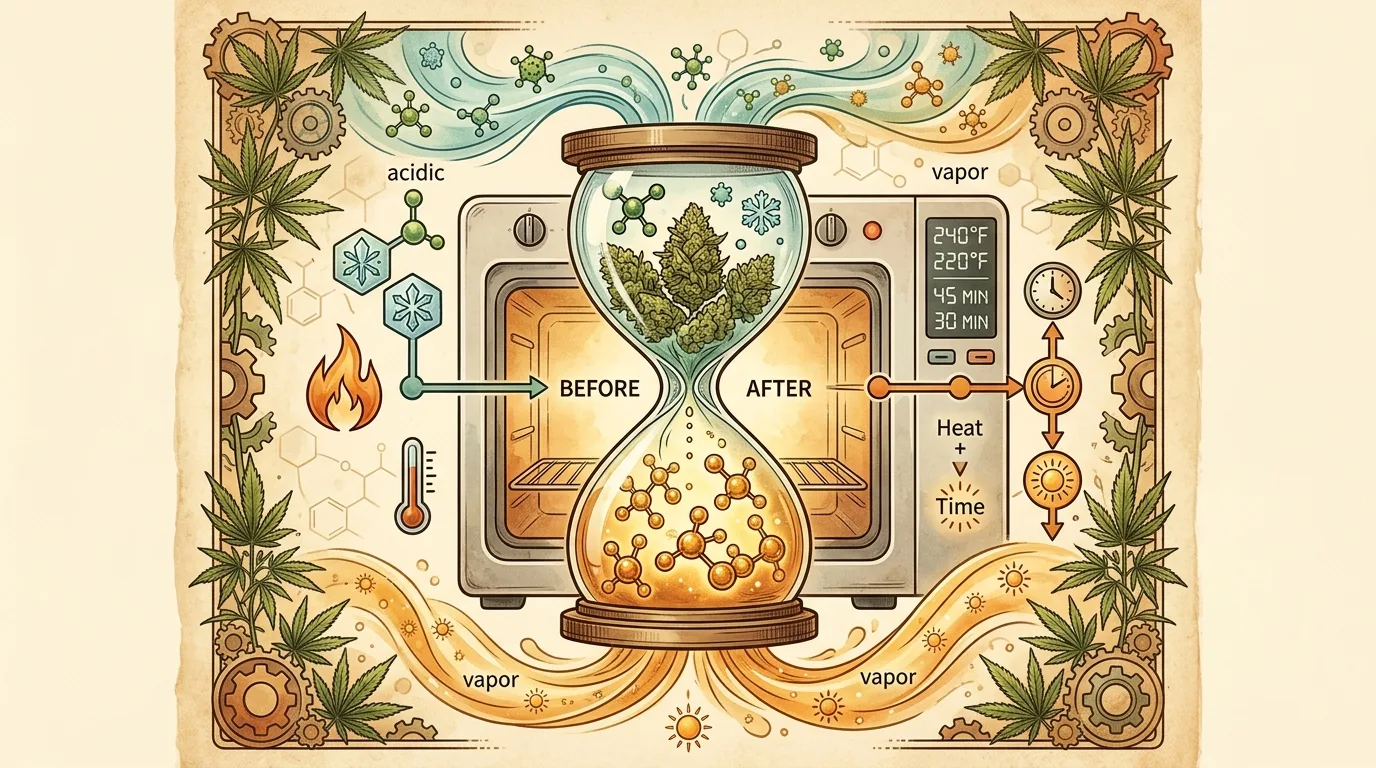
Decarboxylation is simply a chemical reaction triggered by heat. When cannabis reaches certain temperatures, the carboxyl group (COOH) breaks away from THCa and CBDa molecules, releasing it as carbon dioxide (CO₂) and water vapour. What's left behind is the activated cannabinoid your body recognizes and responds to.
The reaction follows predictable patterns based on temperature and time. Higher temperatures cause faster decarboxylation, but they also increase the risk of degrading your cannabinoids into less desirable compounds. THC, for example, will eventually convert to CBN (cannabinol) if exposed to too much heat. CBN is mildly sedating but far less potent than THC, so over-decarboxylation means weaker edibles.
The ideal decarboxylation balances speed with preservation. You want to convert as much THCa to THC as possible while minimizing degradation. Research shows that decarboxylation occurs most efficiently between 105°C and 120°C (220°F to 250°F) over 30 to 45 minutes. Below this range, the reaction is too slow and incomplete. Above it, you risk destroying terpenes and cannabinoids faster than you activate them.
Why Oven Temperature Matters More Than You Think
Home ovens are notoriously imprecise. A dial set to 115°C (240°F) might actually deliver temperatures ranging from 105°C to 125°C depending on your oven's calibration, hot spots, and how often you open the door. This variability is why many decarboxylation guides recommend slightly lower temperatures with longer times. It's safer to decarb at 110°C (230°F) for 40 minutes than risk overshooting at 120°C (250°F) for 30 minutes and ending up with a tray of burnt, CBN-heavy material.
If you're serious about making edibles regularly, invest in an oven thermometer. Place it on the same rack as your cannabis to monitor actual temperatures, not just what your oven claims it's delivering. This small tool will save you from ruining expensive flower with inconsistent heat.
The Standard Oven Decarboxylation Method
Most home cannabis cooks decarboxylate flower in a standard kitchen oven. It's accessible, requires no special equipment, and works reliably if you follow proper procedures. Here's the step-by-step process that produces consistent results.
What You'll Need
- Cannabis flower (any amount; most recipes start with 7-14 grams)
- Baking sheet or oven-safe glass dish
- Parchment paper or aluminum foil
- Oven thermometer (optional but recommended)
- Grinder or your hands to break up buds
Step-by-Step Instructions
Step 1: Preheat your oven to 110°C (230°F). Place your oven thermometer on the middle rack if you're using one. Let the oven fully preheat for at least 15 minutes to ensure even, stable temperatures.
Step 2: Break up your cannabis. You don't need to grind it into powder. Break buds into rice-sized pieces with your fingers or a coarse grind. Smaller pieces decarboxylate more evenly, but dust-fine powder can burn around the edges.
Step 3: Spread cannabis on your baking sheet. Line your sheet with parchment paper first (it prevents sticking and makes cleanup easier). Spread your broken-up flower in a single, even layer. Don't pile it up or leave large chunks, as uneven thickness leads to uneven decarboxylation.
Step 4: Cover with foil (optional). Some cooks loosely tent aluminum foil over their cannabis to contain the smell and protect against uneven oven heat. This isn't mandatory, but it does reduce odour and helps maintain consistent temperature around your material.
Step 5: Bake for 30-40 minutes. Place your sheet in the centre of the oven. Set a timer for 30 minutes initially. After 30 minutes, check your cannabis. It should have shifted from bright green to a toasted, brownish-green colour. If it still looks very green and vibrant, give it another 5-10 minutes. The smell will shift from fresh and grassy to a toasted, almost nutty aroma.
Step 6: Cool completely before using. Remove the sheet from the oven and let your cannabis cool to room temperature. Decarboxylated flower is now ready to infuse into fats like butter or coconut oil. If you're not using it immediately, store it in an airtight container in a cool, dark place.
Visual and Aromatic Cues
Properly decarboxylated cannabis looks darker and smells different than raw flower. The colour shifts from vibrant green to olive, brownish-green, or even light brown depending on the strain and how long you heated it. The aroma becomes earthier, less pungent, and slightly toasted. If your cannabis turns dark brown or black, you've gone too far and degraded most of your cannabinoids. If it still looks and smells like fresh flower, it needs more time.
Once you've mastered decarboxylation, the next step is infusing your activated cannabis into butter or oil. Our complete guide on how to make cannabutter walks you through the infusion process, including ratios, cook times, and straining techniques that produce clean-tasting, potent edibles every time.
Common Decarboxylation Mistakes and How to Avoid Them
Even with clear instructions, first-timers make predictable errors that reduce potency or waste cannabis entirely. Here are the mistakes that cost people the most, and how to sidestep them.
Mistake #1: Skipping Decarboxylation Entirely
This is the big one. Beginners assume that baking cannabis into brownies or simmering it into butter will activate it. As we've covered, typical cooking temperatures don't reliably or fully decarboxylate THCa. You'll get weak, unpredictable results. Always decarboxylate before you infuse or cook.
Mistake #2: Using Temperatures That Are Too High
Setting your oven to 150°C (300°F) or higher to "speed things up" destroys terpenes and converts THC into CBN rapidly. You'll end up with sleepy, low-potency edibles that lack the flavour and effect profile you wanted. Stick to 110°C to 120°C (230°F to 250°F) maximum. Lower and slower wins.
Mistake #3: Not Grinding or Breaking Up Flower Enough
Whole buds or large chunks decarboxylate unevenly. The outside activates while the inside stays raw. Break your flower into small, uniform pieces for consistent results. You don't need a fine powder, just pea-sized or smaller.
Mistake #4: Overcrowding the Baking Sheet
Piling cannabis in thick layers creates hot and cool zones. The flower on the bottom might scorch while the top layer stays under-activated. Spread everything in a single, even layer with space between pieces.
Mistake #5: Not Monitoring Time Carefully
Walking away and forgetting about your cannabis in the oven is an expensive mistake. Set multiple timers. Check your flower at 30 minutes, then every 5 minutes after. Those last few minutes make the difference between perfect activation and ruined material.
Mistake #6: Using Decarbed Cannabis Immediately While Hot
Freshly decarboxylated cannabis is extremely hot and will continue reacting briefly as it cools. Let it reach room temperature before adding it to room-temperature or cold fats. Adding hot cannabis to cold butter can cause uneven infusion and texture issues.
Alternative Decarboxylation Methods
The oven method is standard, but it's not your only option. Depending on your equipment, smell concerns, and desired precision, alternative methods might suit your situation better.
Sous Vide Decarboxylation
Sous vide cooking uses temperature-controlled water baths to heat food in sealed bags. For decarboxylation, place your ground cannabis in a vacuum-sealed or zip-lock bag (remove as much air as possible), then submerge it in water heated to 95°C to 105°C (203°F to 220°F) for 60 to 90 minutes. The water bath maintains perfect, even temperature with no risk of hot spots or burning.
The sous vide method contains smell almost completely since your cannabis is sealed in a bag. The trade-off is longer processing time. Water conducts heat differently than air, so you need extra time to reach full activation. This method is ideal if you live in shared housing or want zero odour leakage.
Instant Pot or Pressure Cooker
Some cannabis cooks use Instant Pots on low pressure settings to decarboxylate. Place cannabis in a mason jar, seal it (but not too tightly, since pressure builds), and cook on low pressure for about 40 minutes. The contained environment minimizes smell, and the results are consistent if you dial in your specific device's quirks.
The downside is that pressure cooking is less forgiving than oven or sous vide methods. Overcooking by even 10 minutes can push you into degradation territory. Start conservatively and adjust based on results.
Specialized Decarboxylation Devices
Several companies sell dedicated decarboxylation machines like the Ardent FX or LEVO. These devices automate temperature and time, removing guesswork entirely. They're convenient and produce reliable results, but they cost $200 to $400 CAD. If you make edibles regularly, the investment might be worth it. For occasional bakers, a standard oven works fine.
How Decarboxylation Fits Into Your Edibles Workflow
Understanding where decarboxylation sits in the larger edibles-making process helps you plan efficiently. Here's the typical workflow for homemade cannabis edibles from flower to finished product.
Step 1: Source quality flower. Your edibles are only as good as the cannabis you start with. Mid-grade or lower-tier flower works fine for edibles since you're not judging bag appeal or smoke smoothness. Focus on cannabinoid content and freshness. If you're buying in bulk for edibles projects, consider value options that offer good potency without premium flower pricing.
Step 2: Decarboxylate your flower. This is where we are now. Use the oven method, sous vide, or your preferred technique to activate your cannabinoids. Don't skip this step or rush it.
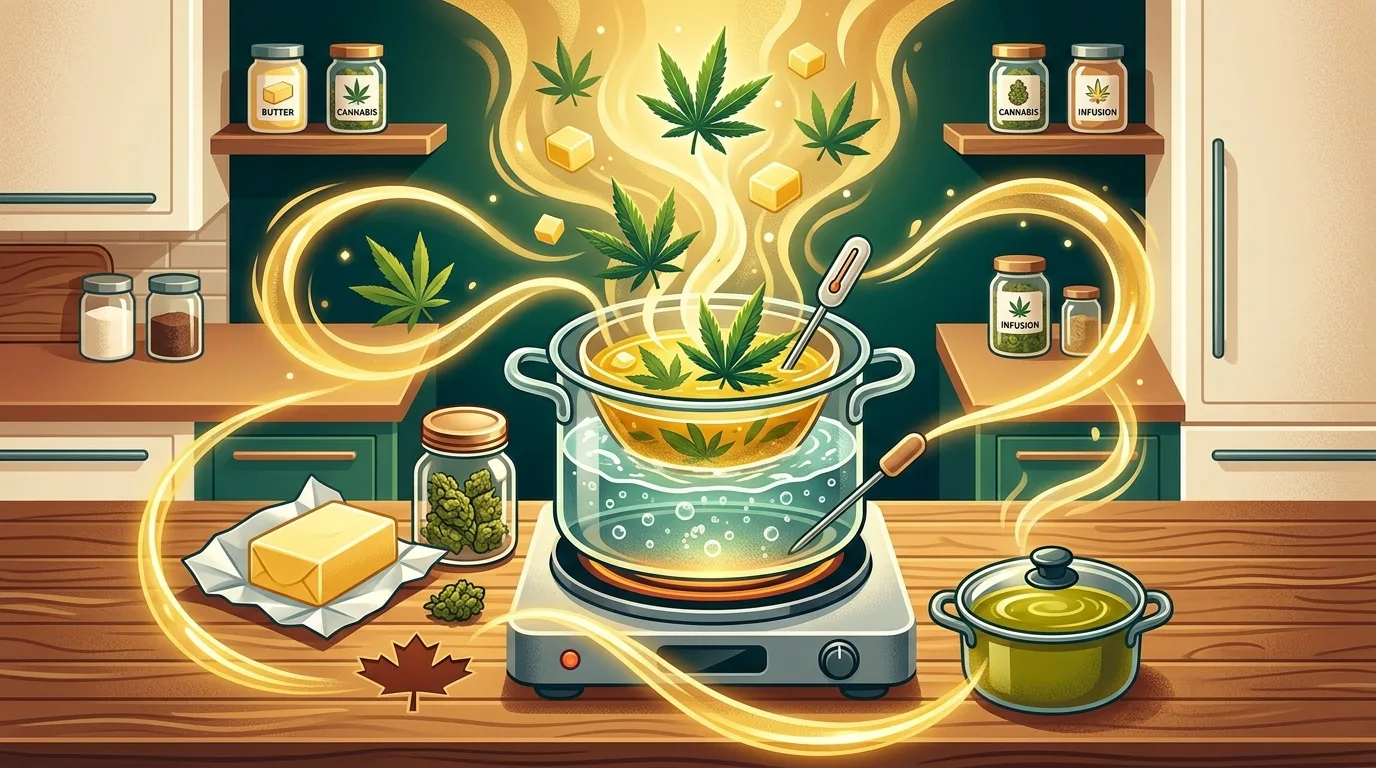
Step 3: Infuse into fat. Cannabinoids are fat-soluble, not water-soluble. You must bind them to butter, coconut oil, olive oil, or another fat to use them in recipes. The infusion process involves gently heating your decarboxylated cannabis with your chosen fat for 2-4 hours, then straining out the plant material. Detailed instructions and ratios are covered in our cannabutter guide.
Step 4: Cook or bake your recipe. Once you have infused butter or oil, treat it like any other ingredient. Substitute it 1:1 for regular butter or oil in your favourite recipes. Brownies, cookies, gummies, savoury dishes, all work as long as your recipe includes fat for the infused ingredient to blend into.
Step 5: Dose carefully and label everything. Homemade edibles are notoriously hard to dose precisely without lab testing, but you can estimate potency based on the amount of cannabis used and the volume of butter produced. Start with small portions (5-10mg THC equivalent if you can estimate it) and wait 90 minutes before consuming more. For more on why edibles hit differently and how to dose safely, check out our article on 11-hydroxy-THC.
Does Decarboxylation Affect Terpenes and Flavour?
Yes, decarboxylation does reduce terpene content. Terpenes are volatile aromatic compounds that evaporate at lower temperatures than cannabinoids. When you heat cannabis to 110°C (230°F) for 30-40 minutes, you'll lose some of the bright, fresh terpene notes that define each strain's smell and taste.
This is an unavoidable trade-off. You need heat to activate cannabinoids, and heat drives off terpenes. The good news is that proper decarboxylation at controlled temperatures preserves more terpenes than smoking or high-temperature cooking. You'll retain enough aromatic compounds to give your edibles some cannabis character, even if they won't taste identical to fresh flower.
If terpene preservation is a priority, consider these strategies: Use slightly lower temperatures (105°C/220°F) for slightly longer times (45-50 minutes). This slower approach activates cannabinoids while minimizing terpene loss. You can also add terpene isolates or cannabis-derived terpenes back into your infusion after straining to boost flavour. These products are available from specialty suppliers and let you dial in specific flavour profiles.
For more on how terpenes shape cannabis effects and flavours, explore our guide on terpenes in weed, which breaks down the major terpene families and what each contributes to your experience.
Calculating Potency After Decarboxylation
Knowing roughly how strong your decarboxylated cannabis is helps you dose your infusions and edibles more accurately. Without lab testing, you'll be estimating, but educated estimates are better than complete guesswork.
Start with the THC percentage of your flower. If your cannabis tests at 20% THC (or if you estimate based on strain reputation and quality), that means each gram contains roughly 200mg of THCa before decarboxylation. Decarboxylation converts THCa to THC at about 87.7% efficiency by weight because you lose the carboxyl group. So 200mg of THCa becomes approximately 175mg of THC after full decarboxylation.
In practice, home decarboxylation is rarely 100% efficient. You'll likely achieve 70-90% conversion depending on your technique, temperature accuracy, and timing. A conservative estimate is that each gram of 20% THC flower yields about 140-160mg of activated THC after decarboxylation and accounting for real-world inefficiencies.
If you decarboxylate 10 grams of 20% flower, you'll have roughly 1,400-1,600mg of THC to work with. If you infuse that into 1 cup (227g) of butter, each tablespoon of butter contains approximately 90-100mg THC. From there, you can calculate per-serving doses based on how much butter each cookie or brownie contains.
These calculations assume no further loss during infusion and cooking, which isn't entirely accurate (you'll lose some cannabinoids when you strain out plant material and some during baking), but they give you a reasonable starting point for dose planning.
Storing Decarboxylated Cannabis
If you decarboxylate a large batch and don't plan to infuse it all immediately, proper storage keeps your activated cannabis potent for weeks or even months. Once decarboxylated, THC is more stable than THCa, but it will still degrade over time if exposed to light, heat, or oxygen.
Store your decarbed flower in an airtight container (mason jars work perfectly) in a cool, dark place. A cupboard or pantry away from the stove or any heat source is ideal. Avoid clear containers in lit areas, as light degrades cannabinoids over time. If stored properly, decarboxylated cannabis maintains potency for 3-6 months. Beyond that, you'll notice gradual loss of strength as THC converts to CBN.
Some people freeze decarboxylated cannabis for long-term storage. This can work, but be aware that repeated freeze-thaw cycles can affect texture and potentially cannabinoid stability. If you freeze, portion your cannabis into smaller containers so you only thaw what you need at one time.
Ready to Start Your Edibles Journey?
Now that you understand decarboxylation, explore our selection of premium cannabis flower perfect for infusion projects. From budget-friendly popcorn buds to top-shelf strains, we have options for every edibles maker.
Shop Cannabis FlowerSlow cookers can work but they're harder to control precisely. Most slow cookers run hotter than ideal decarboxylation temperatures (often 120°C-135°C on low), which can degrade cannabinoids. If you try it, use the lowest setting, monitor with a thermometer, and check frequently. Ovens or sous vide methods offer better temperature control.
Visual and aromatic cues are your best guides. Properly decarboxylated cannabis shifts from bright green to brownish-green or olive coloured, and the smell changes from fresh and grassy to toasted and earthy. If you have a more scientific approach, 30-40 minutes at 110°C (230°F) achieves near-complete conversion for most flower. Over-decarbed cannabis turns dark brown or black and smells burnt.
Yes, smaller particle size does speed up the reaction slightly because more surface area is exposed to heat. However, powder-fine grinds can burn around the edges before the centres fully activate. A coarse grind (rice-sized pieces) balances speed with even heating. Breaking buds by hand into small chunks works fine too.
Yes, hash and concentrates also require decarboxylation before eating, though they decarb faster than flower due to higher cannabinoid concentration and less plant material. Use lower temperatures (around 105°C/220°F) for shorter times (20-30 minutes) to avoid over-activation. Concentrates spread thin on parchment paper work best. Monitor closely as they bubble and settle.
It will create noticeable cannabis odour, though it's less intense than smoking. The smell is earthier and more herbal than fresh flower. To minimize odour, cover your baking sheet with foil, turn on your oven exhaust fan, open a window, or use a sous vide method where cannabis is sealed in a bag. The smell dissipates within an hour or two after you finish.
Temperatures below 100°C (212°F) won't fully activate your cannabis in reasonable timeframes. You might achieve 40-60% conversion over 60-90 minutes, meaning you're wasting nearly half your flower's potential. If you're worried about overheating, 105-110°C (220-230°F) is the sweet spot,low enough to be safe, high enough to work efficiently.