You've probably seen the numbers on cannabis packaging: 20:1, 1:1, 1:20. They look like betting odds or screen resolution settings, but these ratios represent something far more useful for anyone trying to dial in their ideal cannabis experience. The CBD to THC ratio tells you the relative balance between the two most abundant cannabinoids in a given product, and understanding what those numbers mean in practical, experiential terms can transform how you approach cannabis entirely.
Most people start their cannabis journey at one extreme of the ratio spectrum,usually high-THC products with minimal CBD,simply because that's what dominates dispensary shelves. But the ratio spectrum isn't a linear scale of "weak to strong." It's more like a colour wheel of distinct experiences, each band offering something qualitatively different from the others. A balanced 1:1 product doesn't feel like a diluted version of a high-THC strain. It feels different in character, not just intensity.
What CBD to THC Ratios Actually Mean
The ratio format follows a simple pattern: CBD number first, then THC. So a 10:1 ratio means ten parts CBD to one part THC. If a product contains 100mg CBD and 10mg THC, that's 10:1. If it contains 5mg CBD and 5mg THC, that's 1:1. The actual milligram amounts can vary, but the ratio stays constant and tells you the relationship between the two compounds.
When you see flower listed as 1:20 or a vape cart marked 20:1, you're looking at opposite ends of the spectrum. The first number always represents CBD; the second always represents THC. Once you internalize that pattern, you can scan any product label and immediately know whether it leans heavy toward THC, balances both cannabinoids, or emphasizes CBD with just a whisper of psychoactivity.
Why Ratios Matter More Than Total Potency
A 20% THC strain and a 15% THC strain might sound dramatically different on paper, but in actual use, that 5% difference often gets lost in the noise of set, setting, and personal tolerance. The ratio, however, creates qualitative shifts you can feel clearly. A 10% THC strain with 10% CBD (1:1 ratio) will feel profoundly different from a 10% THC strain with 0.5% CBD (20:1 ratio), even though the THC content is identical.
CBD modulates the THC experience in ways that go beyond simple "dilution." It doesn't just reduce intensity; it changes the character of the effect. Think of it less like turning down volume and more like adjusting EQ settings. Different ratios highlight different aspects of the cannabis experience,some emphasize mental clarity, others body sensation, still others a kind of grounded calm that high-THC products rarely deliver on their own.
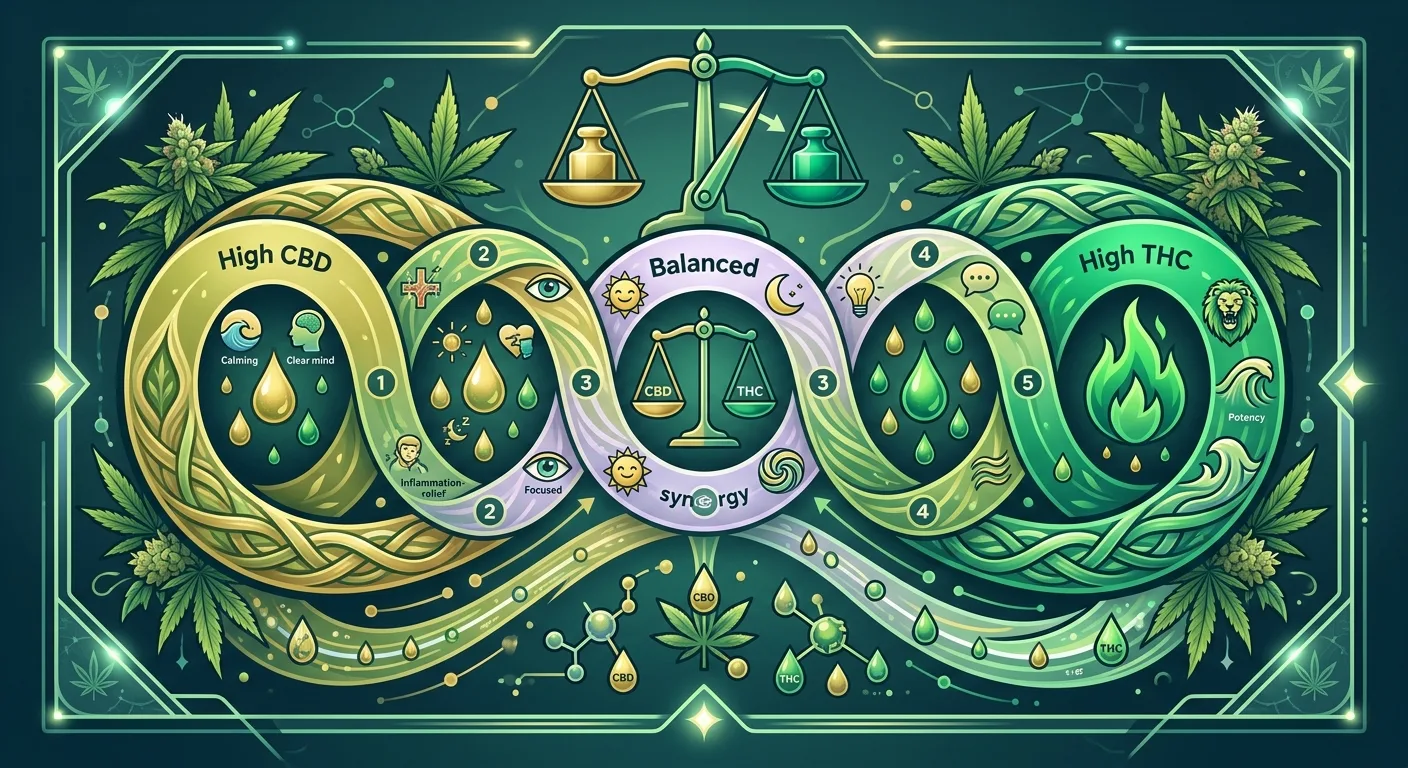
The Ratio Spectrum: What Each Band Feels Like
The ratio spectrum divides into five experiential bands, each with its own personality. These aren't medical claims or therapeutic guidelines; they're descriptive accounts of how different ratios tend to feel for most people during recreational or exploratory use. Your mileage will vary based on tolerance, body chemistry, and context, but these patterns hold remarkably consistent across user reports.
High CBD Dominant (20:1 to 10:1)
Products in this range contain CBD as the overwhelming majority cannabinoid, with just enough THC to activate the entourage effect. A 20:1 product might contain 200mg CBD and 10mg THC. The experience tilts heavily toward body sensation,a gentle physical ease without mental fog or perceptual shifts. Most people report clear-headedness, functional calm, and subtle relaxation that doesn't interfere with work, conversation, or complex tasks.
This ratio band appeals to people who want the somatic qualities of cannabis without psychoactivity, or those who find even moderate THC levels overwhelming. It's also popular as a daytime option, since the CBD provides presence without making you feel altered. The small amount of THC rounds out the effect and prevents the somewhat flat feeling some people get from pure CBD isolate.
CBD Leaning Balanced (5:1 to 3:1)
Here the CBD still dominates, but THC's presence becomes more noticeable. A 5:1 product with 50mg CBD and 10mg THC offers a distinct but manageable psychoactive component. You'll likely feel some mental shift,a gentle mood lift, slight time dilation, enhanced sensory awareness,but the CBD keeps the experience grounded and body-focused.
This range represents a sweet spot for people who enjoy light psychoactivity without intensity. It's forgiving for newer users and appealing for experienced consumers who want effect without impairment. Conversations flow naturally, creativity percolates without racing thoughts, and physical relaxation deepens without sedation. Many people describe this band as "cannabis with training wheels" or "weed you can think on."
True Balance (2:1 to 1:1)
Balanced ratios represent the middle path,equal or near-equal parts CBD and THC. A 1:1 product containing 10mg of each cannabinoid delivers a distinctly biphasic experience where you can feel both compounds working simultaneously. The THC provides noticeable psychoactivity and mental engagement, while the CBD tempers edge and anxiety while adding physical depth.
People often describe balanced ratios as "full-spectrum" experiences where you access the complete range of cannabis effects without tipping too far in either direction. Euphoria arrives but stays grounded. Body sensation deepens but remains comfortable. Mental activity increases but doesn't spiral into loops. This ratio band has developed a devoted following among people who found high-THC products too racy and CBD-dominant products too subtle. Understanding how terpenes interact with these balanced cannabinoids adds another layer of customization to your experience.
THC Leaning (1:2 to 1:5)
As the ratio shifts toward THC dominance, the experience becomes more recognizably "high." A 1:3 product with 5mg CBD and 15mg THC delivers substantial psychoactivity with enough CBD to maintain some guardrails. You'll feel elevated mood, altered perception, time distortion, and enhanced sensory experience, but with less anxiety or overwhelm than high-THC products typically produce.
This range appeals to people who want a clear high but have experienced uncomfortable racing thoughts or paranoia from THC-heavy products. The CBD doesn't eliminate intensity; it shapes it toward a more embodied, less frenetic direction. Many users report this ratio band as ideal for social sessions, creative work, or evening relaxation where you want significant effect without losing the thread of conversations or thoughts.
High THC Dominant (1:10 to 1:20+)
Here we're in classic "weed" territory,products where THC makes up the vast majority of cannabinoid content and CBD appears only in trace amounts. A 1:20 ratio might mean 1mg CBD to 20mg THC. The experience is thoroughly psychoactive, with pronounced effects on perception, mood, cognition, and body sensation. This is the ratio range most recreational products occupy by default.
High-THC ratios deliver peak intensity and the most dramatic perceptual shifts. They're popular for recreational use, deep relaxation, creative exploration, and profound sensory experiences. However, they're also where side effects like anxiety, racing thoughts, and paranoia most commonly appear, especially for newer users or in high doses. If you're exploring these potent options, knowing what to do when cannabis hits too hard becomes essential information.
How to Move Along the Spectrum Session by Session
Ratio litreacy becomes most valuable when you treat it as a navigation tool rather than a fixed destination. Your ideal ratio isn't necessarily constant,it shifts based on context, tolerance, time of day, and what you're trying to accomplish in a given session. The spectrum gives you granular control if you know how to move along it intentionally.
Starting Point Depends on Experience Level
Complete beginners typically benefit from starting in the CBD-dominant or CBD-leaning ranges (10:1 to 3:1) where effects are gentler and more forgiving. This builds familiarity with cannabis's signature sensations without overwhelming intensity. People with some experience but who found high-THC products uncomfortable often find their sweet spot in balanced ranges (2:1 to 1:2).
Experienced users comfortable with psychoactivity might start at balanced ratios and explore both directions,higher CBD when they want functional effect, higher THC when they want peak intensity. There's no shame in any starting point; the goal is finding what works for your body and purposes. Some people discover they prefer CBD-dominant products even after years of high-THC use, simply because the experience better matches their current needs.
Adjusting Ratios Based on Time of Day
Many people develop a ratio routine that shifts through the day. Morning might call for a high-CBD product (15:1) that provides gentle activation without impairment. Afternoon sessions might move toward balanced territory (2:1 or 1:1) for creative work or social time. Evening could shift to THC-leaning ratios (1:3 or higher) for relaxation and recreation when functionality matters less.
This isn't a rigid prescription,it's a pattern that emerges naturally once you understand how different ratios feel at different times. You're essentially using ratios as a dimmer switch for psychoactivity, dialing effect up or down based on what your schedule and activities require. The same person might use three different ratio ranges in a single day depending on context.
Tolerance and Ratio Drift
Regular cannabis use typically builds THC tolerance faster than CBD tolerance, which means your relationship with ratios shifts over time. Someone who started at 1:1 and felt well-balanced might find after a few months that the same ratio feels less pronounced. The natural tendency is to increase THC potency, but another option is shifting the ratio toward higher CBD to restore balance without simply chasing higher doses.
This is where the spectrum concept really shines. Instead of an endless escalation of THC percentages, you can move laterally across ratios to find different experiences. A 1:1 product that feels too subtle might regain impact if you take a few days at 5:1, then return to balance. Or you might find that shifting to 1:2 delivers the intensity you want without requiring a jump to pure THC products. For those considering a reset, our guide to tolerance breaks and balanced product paths explores this strategy in depth.
Practical Tips for Ratio Experimentation
Understanding ratios intellectually is one thing; dialing in your personal preferences requires hands-on exploration. Here's how to experiment systematically rather than wandering the spectrum randomly hoping to stumble on something that works.
Keep a Simple Session Log
You don't need an elaborate journal, but noting ratio, dose, time, and experience helps pattern recognition emerge. After a dozen sessions across different ratios, you'll start seeing which ranges consistently deliver what you're looking for. Write down the ratio, how much you used, what you were doing, and a one-sentence description of how it felt. That's enough data to guide future choices.
Pay special attention to context variables. A 1:1 edible that felt perfect for a Saturday evening hike might feel too intense for a Tuesday work-from-home afternoon. The ratio isn't "good" or "bad" in isolation; it interacts with set and setting. Your log helps you match ratios to contexts rather than searching for one universal answer.
Start Low and Move Gradually
When exploring a new ratio range, err toward lower doses initially. A balanced 1:1 product might hit differently than the high-THC products you're used to, even if the THC content is technically lower. Give your system a chance to experience the new cannabinoid relationship at a manageable level before increasing dose or shifting ratios.
The ratio spectrum isn't a linear progression from "weak" to "strong," so moving from 1:5 to 1:1 isn't necessarily "stepping down." It's a lateral shift to a different experience profile. Approach each new ratio range with fresh eyes rather than assumptions based on THC percentage alone. If you're also exploring different consumption methods, understanding how decarboxylation affects edible potency helps you make smarter dosing decisions.
Try the Same Ratio Across Formats
A 1:1 ratio in flower, a vape cart, and an edible will feel different due to consumption method variables, but the underlying ratio signature remains consistent. Trying the same ratio across formats helps you understand what the ratio contributes versus what the delivery method contributes. You might discover that you prefer balanced ratios in edibles but THC-dominant ratios in flower, or vice versa.
This cross-format exploration also reveals how ratios interact with terpene profiles. A 1:1 flower with heavy myrcene will feel different from a 1:1 cart with dominant limonene, even though the cannabinoid ratio is identical. You're building a multi-dimensional understanding of how various factors combine to create specific experiences.
Common Ratio Misconceptions
As ratio awareness grows, so do myths and misunderstandings. Here are the most common misconceptions that trip up people trying to navigate the spectrum effectively.
Higher CBD Doesn't Mean "Less High"
This is the biggest misunderstanding: that CBD simply dilutes or weakens THC's effects. In reality, CBD modulates how THC expresses itself. A 1:1 product isn't half as intense as a THC-only product with the same THC content; it's a qualitatively different experience. You might feel equally "high" but in a different way,more grounded, less racy, with different qualities emphasized.
Some people actually find balanced ratios more intense in certain dimensions than high-THC products because the CBD brings body sensation and presence into sharper focus. It's not a simple subtraction; it's a rebalancing that highlights aspects of the experience that pure THC products can overshadow with mental stimulation.
Ratios Aren't Medical Recommendations
Different ratios suit different experiential preferences and contexts, but there's no "correct" ratio for specific conditions or outcomes. The therapeutic claims that circulate around certain ratios often lack solid evidence and can mislead people into thinking ratios work like pharmaceutical formulations with standardized effects.
Treat ratios as experiential variables to explore, not prescriptions to follow. What works beautifully for someone else might feel off for you, and vice versa. The goal is personal discovery and preference mapping, not adherence to external recommendations about which ratio "should" work for which purpose.
You Don't Need to Find One Perfect Ratio
Many people approach ratio exploration with the mindset of finding their "magic number" that works for everything. But part of ratio litreacy is recognizing that different contexts call for different balances. You might genuinely prefer 10:1 for mornings, 1:1 for afternoons, and 1:5 for evenings. That's not indecision; that's sophistication.
Building a small rotation of products across different ratio ranges gives you flexibility to match consumption to context. It also helps manage tolerance, since alternating between ratios prevents your system from fully adapting to any single cannabinoid profile. Think of it like having different tools for different jobs rather than searching for one universal implement.
Ratio-Forward Shopping Strategies
Once you understand ratios conceptually, the practical question becomes: how do you actually find products in specific ratio ranges? Cannabis retail doesn't always make this easy, since most merchandising focuses on THC potency and strain names rather than cannabinoid balance.
Read Labels Carefully
Product packaging legally must list CBD and THC content, though the prominence and clarity of this information varies. Look for actual milligram or percentage amounts, not just marketing descriptions like "balanced" or "chill." Calculate the ratio yourself if it's not stated explicitly,divide the CBD amount by the THC amount to get the first number, or vice versa if you're looking at a THC-dominant product.
Flower products sometimes list cannabinoid ranges (like "18-22% THC, 0.5-1.5% CBD") rather than exact numbers. Use the midpoint of each range to estimate the ratio. An 20% THC, 1% CBD flower would be roughly 1:20. This isn't perfect precision, but it gets you in the right ratio neighbourhood for exploration.
Building a Balanced Shelf
A well-stocked personal cannabis collection includes representatives from across the ratio spectrum. You don't need dozens of products,just a few key ratio points that cover your common use cases. One high-CBD option (10:1 or higher), one balanced product (2:1 to 1:2), and one THC-dominant choice (1:5 or higher) gives you flexibility for most contexts.
As you refine preferences, you might expand into more specific ratio ranges or duplicate a particularly useful ratio across different formats and terpene profiles. But starting with three ratio points prevents decision paralysis and gives you enough range to discover patterns in your response to different cannabinoid balances. When shopping for quality options, knowing how to calculate cannabis value helps you invest in ratio diversity without breaking your budget.
Asking Useful Questions
When shopping in person or browsing online, ratio-specific questions help you find what you're looking for faster. Instead of asking "what's your strongest product?" try "what do you have in a 1:1 or 2:1 ratio?" Staff familiar with cannabinoid ratios will immediately understand what you're seeking and can point you toward relevant options.
Similarly, ask about ratio availability in specific formats: "Do you have any balanced vape carts?" or "What's your highest CBD flower that still has noticeable THC?" This signals that you're shopping with intention rather than browsing randomly, which tends to elicit more useful recommendations. As the cannabis market matures, ratio litreacy among both consumers and retail staff continues improving.
Explore Balanced Cannabis Options
Browse our selection of products across the full CBD to THC spectrum. From high-CBD to balanced to THC-dominant, find the ratio that matches your context.
Shop By RatioMost beginners find success starting in CBD-dominant ranges like 10:1 or 5:1, where effects are gentler and more forgiving. This builds familiarity with cannabis sensations without overwhelming intensity. Balanced ratios (1:1 or 2:1) also work well for first-timers who want noticeable effect with built-in moderation. There's no universal answer since individual body chemistry varies, but these ranges offer the most gradual introduction to psychoactivity.
Yes, combining products is a valid way to fine-tune ratios between standard offerings. Mixing a high-CBD product with a THC-dominant one lets you dial in proportions that might not exist in pre-made form. Just track the actual milligrams from each product to calculate your final ratio, and start with lower total doses when experimenting with combinations until you understand how they interact for you personally.
Ratios influence the character and intensity of effects more than duration, though some people report that balanced and CBD-leaning ratios feel like they wear off more gradually than pure THC products. The CBD component may smooth out the comedown experience. Duration depends more on consumption method (edibles last longer than inhalation) and dose than on ratio alone, though the subjective experience of that duration can feel quite different across ratio ranges.
Cannabis retail evolved around THC potency and strain branding before ratio awareness became widespread. Most merchandising still reflects that legacy, though this is gradually changing as consumers become more cannabinoid-litreate. The market took years to move from strain-centric to effect-based shopping; ratio-forward organization represents the next evolution. In the meantime, learning to read labels and calculate ratios yourself gives you a shopping advantage.
The ratio provides the fundamental cannabinoid relationship, but terpene profiles, minor cannabinoids, and consumption methods all influence the final experience. A 1:1 ratio in a myrcene-heavy indica will feel different from a 1:1 limonene-dominant sativa, even though the CBD to THC balance is identical. Think of ratio as the foundation and other variables as the architecture built on that foundation,both matter to the final structure.
Your body builds tolerance to individual cannabinoids rather than to ratios per se, but since THC tolerance typically develops faster than CBD tolerance, your experience of a given ratio will shift over time. A 1:1 product that felt balanced initially might start feeling more CBD-dominant after regular use as your THC tolerance climbs. Rotating between different ratios or taking periodic breaks helps maintain sensitivity across the spectrum.
Finding Your Personal Ratio Map
The CBD to THC ratio spectrum isn't a ladder you climb toward some objective peak,it's a landscape you explore to find terrain that suits your needs in different situations. What makes ratio litreacy valuable isn't discovering one magic number, but developing fluency with the full range and understanding which balances serve which contexts in your life.
Start somewhere sensible based on your experience level and preferences, then move deliberately along the spectrum rather than randomly sampling. Pay attention to patterns in how different ratios feel and which ones consistently deliver what you're seeking. Build a small rotation that gives you options across the range, and don't be surprised when your preferences evolve with experience and changing life circumstances.
The numbered ratios on labels aren't abstract chemistry,they're experiential signatures that describe how products will likely feel. Learning to read them fluently transforms cannabis consumption from guesswork into navigation, giving you granular control over one of the most important variables in the entire plant's effects. That knowledge pays dividends session after session, year after year, as your relationship with cannabis deepens and becomes more sophisticated.