If you've ever bought a THC cart, an edible or a drink, you've almost certainly consumed distillate. It's the most common cannabis extract on the market, and the one people know least about.
That's because distillate is designed to disappear. It has almost no taste, no smell and no strain personality. It's pure potency that other products are built around.
That isn't a criticism. It's the job. Here's what distillate is, what the process strips out, and how to decide whether a distillate cart or a pricier live resin cart is right for you.
Quick answer: Distillate is a highly refined cannabis oil, usually 85 to 95% THC or more, made by stripping away nearly everything except the main cannabinoid. It's consistent, potent and affordable, which is why most carts and edibles use it. The trade-off is flavour: natural terpenes are removed, so most distillate carts add flavour back.
What is distillate?
Distillate is cannabis oil that has been purified until it's almost entirely one cannabinoid, usually THC. It's a thick, clear-to-amber oil with little natural aroma.
Think of it as the vodka of cannabis. The process aims for purity and neutrality, not character. Whatever made the original plant smell like gas or lemons is gone, and what's left is potency.
That neutrality is why it's everywhere. Distillate mixes cleanly into gummies, chocolates and drinks without tasting like a lawn. It also fills carts at a predictable potency, batch after batch.
How is distillate made?
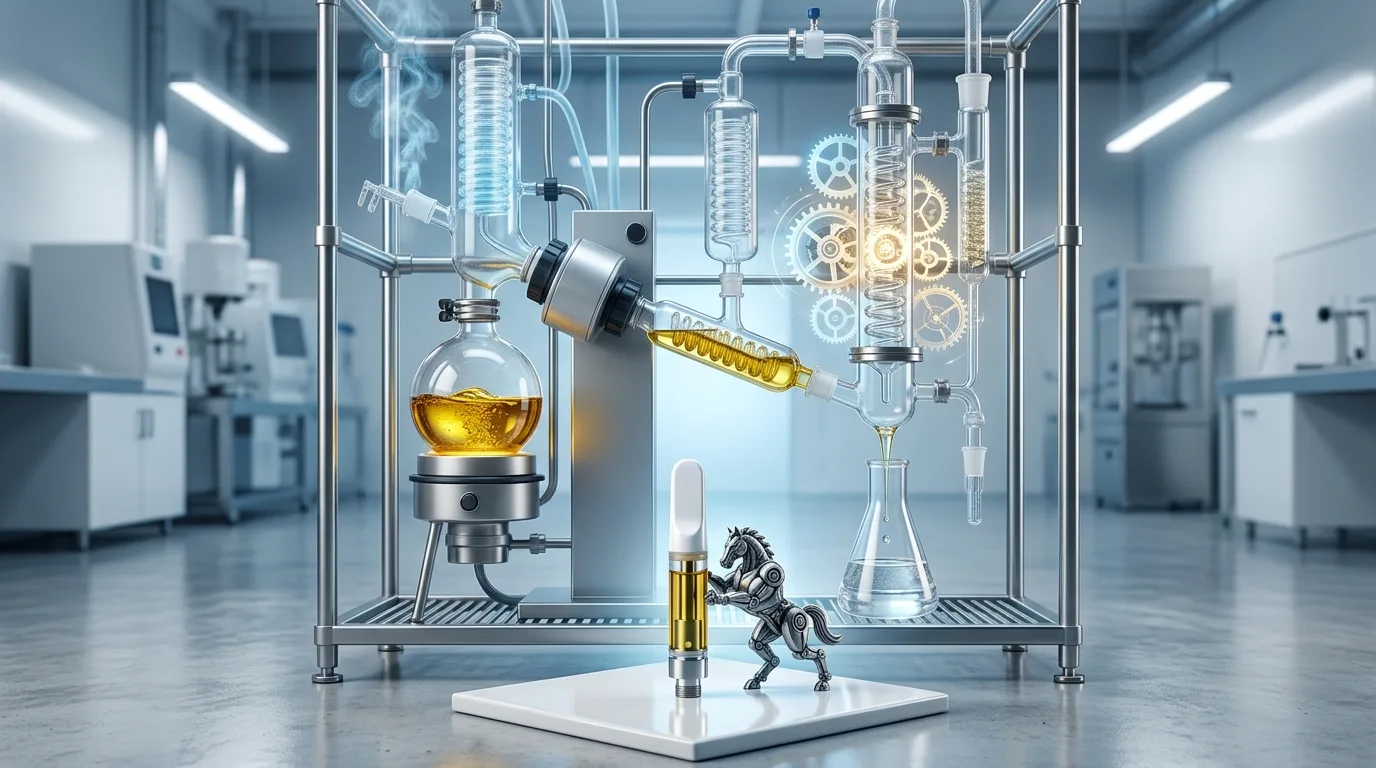
Distillate starts as a crude cannabis extract and goes through several rounds of refinement. The exact methods vary by producer, but the broad steps look like this:
-
Extraction. Plant material is soaked in a solvent such as ethanol or CO2 to pull out cannabinoids, terpenes, fats and waxes. The result is a dark, crude oil.
-
Winterization. The crude oil is mixed with ethanol and chilled so fats, lipids and plant waxes solidify and can be filtered out.
-
Decarboxylation. The oil is heated to convert THCA, the raw form in the plant, into active THC. This is why distillate works in edibles without further cooking.
-
Distillation. Under a vacuum, the oil is heated so compounds separate by boiling point. THC is collected as its own fraction, and many producers run it through more than once for higher purity.
The result is a viscous, golden oil that can test well above 90% THC.
What does distillation strip out?
Nearly everything that makes a strain distinctive. Here's what survives and what doesn't:
|
Compound |
After distillation |
Why it matters |
|
THC |
Kept and concentrated |
The main source of potency |
|
Terpenes |
Removed or heavily degraded |
They carry the strain's flavour and aroma |
|
Minor cannabinoids |
Mostly reduced |
Some may shape the experience |
|
Fats, waxes and chlorophyll |
Removed |
Their removal makes the oil clean and smooth |
|
Plant flavour |
Gone |
That's why distillate tastes neutral |
Terpenes are the big loss. They boil at lower temperatures than THC and don't survive the heat and vacuum of distillation intact. That's why pure distillate is often described as flavour-flat.
Why do distillate carts still have flavour?
Because producers add terpenes back after distillation. That's how a distillate cart can be labelled "Blue Dream" and taste a bit like it.
The terpenes usually come from one of two sources:
-
Botanical terpenes are extracted from non-cannabis plants such as citrus, pine or pepper, then blended to mimic a strain. They're cheap and consistent. Flavour can be close, but it isn't the original plant.
-
Cannabis-derived terpenes (CDT) are collected from cannabis itself. They tend to taste more authentic and usually cost more.
Neither recreates the exact chemistry of the original strain. You're getting a reassembled profile: real THC plus a flavour built to resemble the strain.
Distillate vs live resin
This is the decision most cart buyers actually face. Here's the comparison in one table:
|
Distillate cart |
Live resin cart |
|
|
Starting material |
Dried or cured plant, often trim |
Fresh plants frozen at harvest |
|
Typical THC |
Very high, often 85 to 95%+ |
High, usually lower than distillate |
|
Terpenes |
Removed, then added back |
Native terpenes preserved |
|
Flavour |
Clean, consistent, can taste generic |
Rich, strain-specific, can vary by batch |
|
Strain character |
Mostly flavour-deep |
Closer to the original plant |
|
Consistency |
Very consistent |
Varies with the harvest |
|
Price |
Lower |
Higher |
|
Best for |
Value, predictable potency, edibles |
Flavour, strain character |
For the solventless option at the premium end, see our live resin vs live rosin explainer.
Is distillate good or bad?
Neither. It's a tool, and it's very good at its job.
Distillate's strengths are real. It's potent, so a little goes a long way. It's consistent, so the cart you buy next month hits like this one. It's affordable, which is why it fills most of the vape menu. It's also discreet, because neutral oil smells less than terpene-heavy products.
The weaknesses are equally real. It tastes generic compared with live products, and strain names on distillate carts describe added flavour more than distinct chemistry. Very high THC with no terpene buffer can also feel sharp, so start slow if you're new to carts.
Pick distillate if you:
-
Want the most THC for your money
-
Care more about consistency than flavour nuance
-
Use carts casually and don't want to chase strains
-
Want a neutral base for edibles or cooking
Pick live resin if you:
-
Care about flavour and want each strain to taste distinct
-
Notice the difference between strains and want to keep it
-
Don't mind paying more for a premium hit
Is distillate safe?
No inhaled product is risk-free. The clearest, best-documented danger with THC carts, though, comes from what gets added to them, especially from unknown sources.
In the 2019 vaping lung-injury outbreak known as EVALI, the US Centers for Disease Control and Prevention strongly linked many cases to vitamin E acetate. It had been added as a cutting agent to thicken illicit THC carts. The CDC advised that it should never be added to vaping products.
What that means for you:
-
Ask for lab results. A certificate of analysis should show potency and screening for contaminants. Our guide to reading a COA shows what to look for.
-
Be wary of suspiciously cheap carts. A price far below the market can signal cutting agents.
-
Use reliable hardware. Low-voltage settings protect both flavour and the coil. Our 510 battery guide covers the right settings.
Frequently asked questions
What is THC distillate?
THC distillate is a highly refined cannabis oil that is usually 85 to 95% THC or more. It's made by extracting cannabis, removing fats and waxes, activating the THC with heat, and distilling it to strip out nearly everything else.
How is distillate different from live resin?
Distillate is purified to mostly THC, so the plant's natural terpenes are removed and flavour is usually added back. Live resin is made from fresh-frozen plants and keeps the native terpene profile. Distillate is more potent and consistent, while live resin tastes richer and more strain-specific.
Why does distillate have no taste?
Terpenes, the compounds behind cannabis flavour and aroma, boil at lower temperatures than THC. They don't survive distillation intact, which leaves a neutral, nearly flavourless oil.
Do distillate carts have terpenes?
Most do, but they're added back after distillation. They come either from non-cannabis plants (botanical terpenes) or from cannabis (cannabis-derived terpenes). Neither recreates the original plant's full chemistry.
Is distillate stronger than flower?
Yes, by potency. Distillate is commonly 85 to 95% THC or more, while most flower tests between about 15 and 30%. A small amount of distillate delivers much more THC than the same weight of flower.
Is distillate safe to vape?
No inhaled product is risk-free, but the clearest danger comes from additives in untested carts. The CDC strongly linked the 2019 EVALI lung-injury outbreak to vitamin E acetate used as a cutting agent in illicit THC carts. Choose lab-tested products and avoid carts from unknown sources.
Is distillate used in edibles?
Yes. Distillate is already decarboxylated and nearly flavourless, so it blends easily into gummies, chocolates and drinks without a strong cannabis taste. That's why most commercial edibles use it.
The bottom line on distillate
Distillate is the workhorse of cannabis extracts: potent, predictable and affordable, with flavour added rather than inherited.
If you want reliable THC at a good price, a distillate cart is the sensible pick, and there's no reason to feel you're settling. If you want a cart that tastes and feels like a specific strain, that's what live resin is for.
Know which one you're buying, check the lab results, and you'll get exactly what you paid for.
Find your cart
From value distillate to terpene-rich live resin, in 1g to 6g sizes and disposables.
Want the full-flavour tier? Browse live resin. Need a battery? See vape cartridges and our 510 battery guide.