You've just bought your first THC vape cartridge, screwed it onto something that looked compatible, and now you're staring at a device that blinks three times and refuses to heat. Or maybe your cart tastes burnt after two puffs. Or it works fine for a week, then suddenly stops mid-session. Before you blame the cartridge, let's talk about the hardware connecting your lips to that distillate: the 510 thread battery. This small piece of technology dictates flavour quality, vapour production, cart longevity, and whether your Thursday evening goes smoothly or turns into a troubleshooting session.
Most cannabis consumers learn about 510 thread batteries backward. They buy a cart, grab whatever battery the budtender hands them, and only start researching after something goes wrong. This guide reverses that approach. We're covering what 510 threading actually means, how voltage settings change your experience, why preheat modes exist, proper battery care that extends hardware life, and most importantly, how to distinguish between a faulty cartridge and a battery that's sabotaging perfectly good oil. By the end, you'll know exactly what to look for in a battery, how to adjust settings for different cart types, and when that "broken" cartridge just needs different power delivery.
What 510 Thread Actually Means and Why It Matters
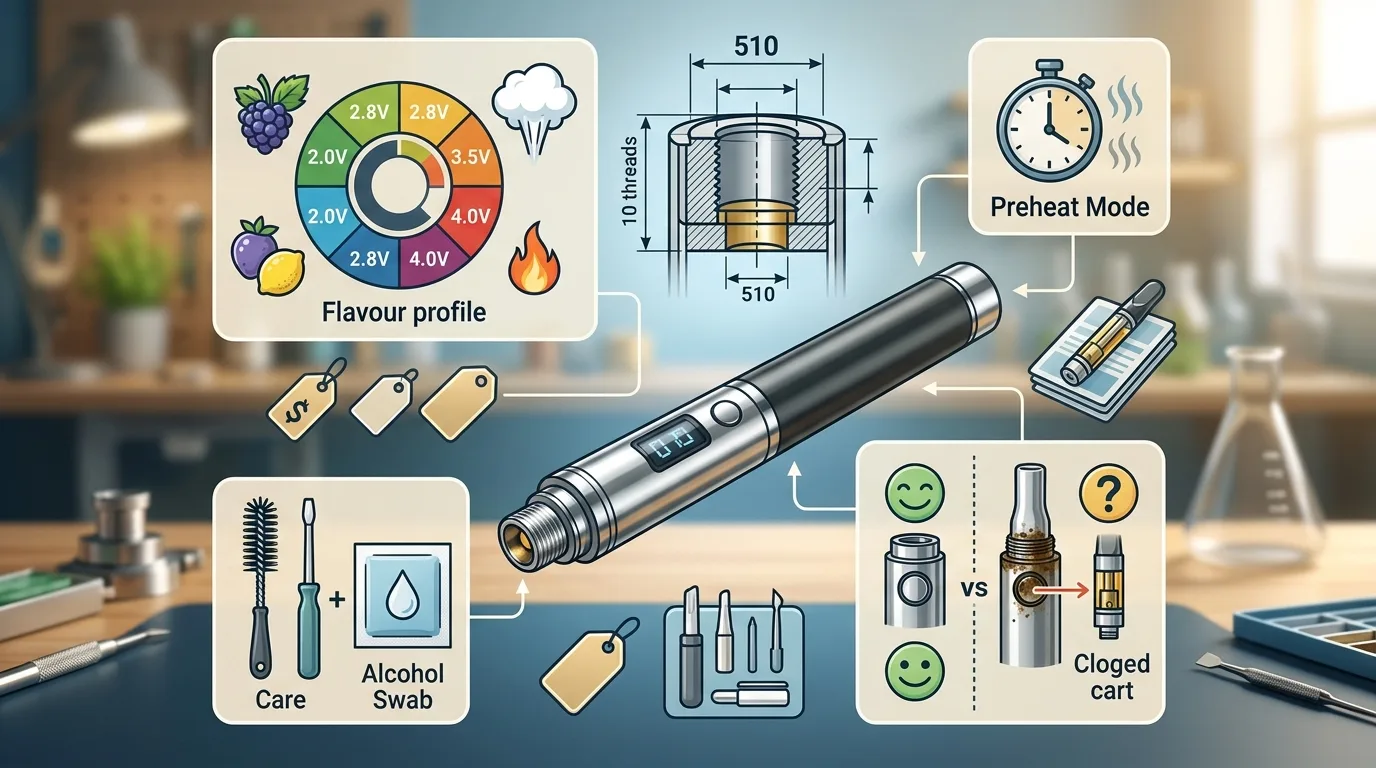
The term "510 thread" refers to a specific type of screw threading: 10 threads at 0.5mm pitch. This standardization emerged from early e-cigarette manufacturing and became the universal connection standard for vape cartridges and batteries. When you see "510 compatible" on packaging, it means the cart and battery share this threading pattern and will physically screw together.
But physical compatibility doesn't guarantee electrical compatibility. The 510 standard only covers the mechanical connection, not the voltage output, resistance tolerance, or airflow design. A budget gas station battery and a temperature-controlled device from a dedicated vape shop both use 510 threading, but they deliver dramatically different experiences with the same cartridge. The threading is just the handshake; what happens after determines whether you taste terpenes or scorched cotton.
Threading Quality Variations
Not all 510 threading is machined equally. Cheap batteries often have loose threading that creates weak electrical contact, leading to intermittent firing or connection failures. Higher-quality batteries feature precision-machined threads with spring-loaded centre pins that adjust to different cartridge lengths, ensuring consistent contact regardless of cart brand. This centre pin flexibility matters more than most users realize. Some cartridges sit deeper than others; a fixed centre pin might not make contact, while a spring-loaded pin accommodates variations in cart manufacturing.
The magnetic adapters many modern batteries use solve threading wear issues entirely. You screw a small magnetic collar onto your cart once, then snap the cart onto the battery magnetically. This eliminates repeated threading wear on both components and makes switching between carts effortless. If you use multiple cartridges regularly, magnetic connection batteries save significant wear and tear while improving user experience.
Voltage Settings and Flavour: The Temperature Sweet Spot
Voltage control is where battery quality separates into tiers. The power you deliver to a cartridge's heating element directly affects vapour temperature, which determines what compounds vapourize and how they taste. Too low, and you get weak vapour with minimal effects. Too high, and you burn terpenes while producing harsh, unpleasant hits that waste oil and damage coils.
Most THC distillate cartridges perform best between 2.4V and 3.3V. Live resin carts with higher terpene content prefer the lower end of that range (2.4V-2.8V) to preserve delicate aromatics. Standard distillate carts tolerate 3.0V-3.3V without flavour degradation. High-quality live resin products especially benefit from precise temperature control, as their complex terpene profiles degrade quickly above certain thresholds.
Reading Voltage vs Temperature Settings
Some batteries display voltage (2.4V, 3.0V, 3.6V), while others show temperature (315°F, 365°F, 420°F). Both systems control the same variable: how hot the coil gets. Voltage is more common on budget and mid-range devices; temperature control appears on premium batteries with better circuitry. Temperature settings account for coil resistance automatically, providing more consistent performance across different cartridge types.
The practical difference: voltage requires you to adjust based on cartridge resistance and personal preference through trial and error. Temperature settings let you dial in a specific heat level regardless of the cart you attach. Neither is inherently better, but temperature control removes one variable from the equation. If you frequently switch between distillate, live resin, and sauce carts, temperature control simplifies finding optimal settings for each.
The Three-Setting Colour Code
Entry-level variable voltage batteries typically offer three settings indicated by LED colour: green (low, around 2.8V), blue or yellow (medium, around 3.2V), and red (high, around 3.6V or higher). These colour codes aren't standardized across brands, so always check your specific battery's manual. What matters more than memorizing colours is understanding which setting preserves flavour versus which produces bigger clouds at the cost of taste.
Start every new cart on the lowest setting for the first few hits. This primes the coil gently and lets you taste the terpene profile before applying higher heat. Many users immediately crank batteries to high settings and wonder why their live resin tastes like burnt plastic within a week. The coil needs gentle heat initially to saturate properly; aggressive voltage right away can scorch wicking material before oil fully penetrates.
Preheat Mode: When and Why You Need It
Preheat (or "warm-up") mode applies low voltage for several seconds before you inhale, heating oil to improve flow without firing the coil at full power. This feature addresses a specific problem: thick oil that doesn't wick efficiently at room temperature. Cold distillate moves slowly; preheating makes it more viscous so the coil has adequate oil before you draw, preventing dry hits and burnt taste.
Most preheat functions activate with two or three rapid button clicks (depending on battery model), running for 10-15 seconds at around 2.0V. You'll see the LED pulse during preheat, then it either shuts off automatically or switches to standby for your draw. Not every cart benefits from preheat. Thin distillates and high-terpene live resins often wick fine without it; thick winterized distillates and CDT (cannabis-derived terpene) oils with higher viscosity see the most improvement.
When Preheat Solves Cart Problems
If your cart produces weak vapour on the first hit but improves with subsequent draws, preheat eliminates that warm-up period. If you get occasional burnt tastes despite proper voltage settings, the coil might be running dry between sessions; preheat redistributes settled oil. If you've experienced clogged cartridge issues where oil seems stuck in the intake holes, preheat gently liquefies blockages without aggressive draws that can flood the coil.
Overusing preheat wastes battery charge and can degrade oil quality faster by repeatedly heating compounds without consumption. Reserve it for cold conditions, very thick oils, or carts that haven't been used in several days. Habitual preheating before every session is usually unnecessary and counterproductive.
Battery Care That Actually Extends Hardware Life
Most 510 batteries fail from user behaviour, not manufacturing defects. Lithium-ion cells in vape batteries degrade from charge cycles, temperature extremes, and mechanical stress. Proper care can triple functional lifespan, saving money and reducing frustration from mid-session failures. These practices apply to all rechargeable cannabis hardware, from basic stick batteries to premium box mods.
Charging Habits That Matter
Never fully drain your battery before charging. Lithium-ion cells prefer partial discharge cycles (charging at 20-40% remaining) over complete depletion. Letting your battery die repeatedly reduces total charge capacity over time. Similarly, you don't need to charge to 100% constantly; stopping around 80-90% reduces stress on the cells. These optimization tactics extend battery life by hundreds of cycles, which translates to years of daily use versus months.
Use the manufacturer-provided charger or a quality USB cable rated for your battery's specifications. Cheap gas station cables can deliver inconsistent current, causing overheating or undercharging. Never charge batteries in extremely hot environments like a car dashboard in summer; heat accelerates cell degradation dramatically. Charging speed varies by battery capacity, but most 510 batteries fully charge in 1-3 hours. If charging takes significantly longer or the battery gets uncomfortably hot during charging, stop using that charger immediately.
Storage and Connection Maintenance
Store batteries and cartridges separately when not in use for extended periods. Leaving a cart screwed onto a battery for weeks creates constant slight electrical drain and can corrode connection points from residual oil seepage. If you won't use a battery for a month or more, charge it to around 50% before storage. This mid-range charge level preserves cell health better than storing fully charged or depleted.
Clean the 510 connection threading monthly with isopropyl alcohol on a cotton swab. Oil creeps down cartridge exteriors and accumulates on threads, creating insulation that weakens electrical contact. This residue buildup is responsible for many "cart won't fire" complaints that users blame on faulty carts when the battery connection is actually blocked. A quick cleaning solves connection issues that otherwise seem like hardware failure.
Temperature Extremes to Avoid
Don't leave batteries in cars, especially during Canadian winters or summer heat waves. Lithium cells lose significant capacity below -10°C and can permanently damage above 45°C. Room temperature storage (15-25°C) is ideal. If your battery gets very cold, let it warm to room temperature gradually before use; firing a freezing battery can crack internal components or cause the cell to fail under load.
Troubleshooting: When Your Cart Problem Is Actually Battery Related
Users typically blame cartridges when something goes wrong, but battery issues cause at least half of all vaping problems. Recognizing battery-related symptoms saves you from discarding perfectly good carts or contacting customer service about oil when the hardware is at fault. Here's how to isolate whether the battery or cart is failing.
The Three-Blink Error Code
Most 510 batteries blink three times to indicate a connection issue or resistance problem. This doesn't mean the cart is broken; it often means the battery can't read the cart's resistance properly or the centre pin isn't making contact. First, check that your cart is screwed in firmly but not overtightened. Overly tight connections can actually push the centre pin down too far, breaking contact. Try unscrewing slightly; if the three-blink pattern stops, you've found the sweet spot.
If adjusting tightness doesn't work, clean both the cart's threading and the battery's centre pin with isopropyl alcohol. Let both dry completely, then reconnect. Still blinking three times? Test the cart on a different battery if available. If it works on another battery, your original battery's centre pin might be stuck or damaged. If it fails on multiple batteries, the cart's connection is likely faulty.
Weak Vapour or No Production
When a cart produces very little vapour despite appearing full of oil, voltage is usually the culprit. Your battery might be set too low, or its charge could be depleted to the point where it can't deliver adequate power. First, try increasing voltage by one setting. If that doesn't improve production, fully charge the battery and test again. Batteries deliver inconsistent power as they approach empty; what works at 80% charge might fail at 15%.
Persistent weak production on a fully charged battery at proper voltage suggests the battery's output capacity has degraded from age. Lithium cells lose maximum current delivery over time; older batteries can't provide the amperage needed for proper vapourization even though they still charge. This is why batteries work fine when new but gradually produce weaker hits with the same carts months later. If your battery is over a year old with heavy use, declining performance is normal wear rather than a defect.
Burnt Taste at Proper Settings
If you're experiencing burnt taste despite using appropriate voltage for your cartridge type, the battery might be delivering inconsistent power or producing voltage spikes. Cheap batteries often lack regulation circuitry that smooths power delivery; they can spike well above their rated voltage during draws, scorching oil momentarily. This problem appears as occasional harsh hits mixed with normal ones, rather than consistently burnt taste.
Test this by trying the cart on a quality regulated battery. If the burnt taste disappears, your original battery's voltage regulation has failed or was never adequate. Unfortunately, this can't be repaired; replacing the battery is the only solution. This is why investing in a quality battery with proper circuitry pays dividends in both cart longevity and experience consistency.
Cart Leaking or Flooding
While most leaking is cart-related, battery behaviour can contribute. If you're using preheat mode excessively or running very low voltage that doesn't fully vapourize drawn oil, liquid can accumulate in the mouthpiece and airpath. The oil puddles rather than vapourizing, eventually leaking out. Adjusting voltage upward slightly often solves "leaking" that's actually incomplete vapourization.
Similarly, leaving a cart attached to a battery in hot environments causes oil to thin and leak through seals that normally contain it. Whether you're using cartridges or disposables, proper storage temperature prevents most leak issues attributed to cart defects.
Choosing the Right Battery for Your Usage Pattern
Battery selection depends on how you consume cannabis through carts. Occasional users have different needs than daily consumers. Someone who uses one cart every few months can get by with an entry-level stick battery; someone cycling through multiple carts weekly benefits from features that justify higher upfront cost.
Entry-Level Stick Batteries ($15-$30)
Basic stick-style batteries work fine for beginners or light users. They offer 1-3 voltage settings, simple button operation, and 280-350mAh battery capacity that lasts a few days with moderate use. Look for units with passthrough charging (use while charging) and automatic shutoff after 10 seconds of continuous draw to prevent accidental firing in pockets or bags.
The main limitation is lack of precision. You can't fine-tune voltage for specific cart types, and lower-quality units may deliver inconsistent power. But for someone trying vaping for the first time or only using carts occasionally, spending more on advanced features isn't necessary. Just ensure the battery has overcharge protection and a reputable brand name rather than buying the absolute cheapest option.
Mid-Range Variable Voltage ($30-$60)
This tier adds true variable voltage control, better battery capacity (400-650mAh), and improved build quality. Features like preheat mode, precise voltage adjustment in 0.1V increments, and LED battery life indicators become standard. These batteries often include magnetic adapters for easy cart switching and USB-C charging for faster top-ups.
For daily users working through standard gram cartridges regularly, mid-range batteries offer the best value proposition. You get sufficient control to optimize different cart types without paying for features most users won't utilize. Build quality improvements mean these batteries typically last 12-18 months with proper care versus 6-9 months for budget options.
Premium Temperature Control ($60-$120+)
High-end batteries feature digital displays showing exact temperature or voltage, temperature control modes that automatically adjust power based on coil resistance, and significantly larger capacity (900-1500mAh) that can last a week or more between charges. Some include session timers, draw counters, and even Bluetooth connectivity for app-based control.
These features benefit experienced users who want maximum control over their experience or those using expensive live resin and rosin carts where preserving terpenes justifies the investment. The improved circuitry also protects premium carts from voltage spikes and overheating. If you're regularly purchasing $50-$80 cartridges, a $80 battery that extends their lifespan and optimizes flavour pays for itself quickly.
Battery Safety and Lithium-Ion Cell Care
510 batteries use lithium-ion cells identical to those in smartphones and laptops. While modern batteries include safety features like overcharge protection and short-circuit prevention, user awareness still matters. Following basic safety practices prevents the rare but serious failures that make news headlines.
Warning Signs of Battery Failure
Stop using a battery immediately if you notice unusual heat during charging or use beyond normal warmth. If the battery casing swells, cracks, or deforms in any way, discontinue use and dispose of it properly at an electronics recycling centre. Never attempt to repair a damaged lithium-ion battery; the fire risk isn't worth salvaging a $30 device.
If your battery starts tasting metallic, shuts off randomly during draws, or produces unusual sounds (clicking, hissing), internal components are failing. These symptoms indicate compromised internal connections or cell degradation. Again, replacement is the only safe option. While these catastrophic failures are uncommon in quality batteries, recognizing early warning signs prevents escalation to more dangerous situations.
Proper Disposal of Dead Batteries
Don't throw 510 batteries in household garbage. Lithium-ion cells require special recycling to recover materials and prevent environmental contamination. Most electronics retailers and municipal waste facilities accept them in dedicated battery recycling bins. Some cannabis retailers also collect dead vape batteries for proper disposal, though policies vary by province and municipality.
Before recycling, fully discharge the battery by leaving it on (not attached to a cart) until the LED indicator shows empty. This reduces fire risk during transportation and processing. Tape over the 510 connection to prevent accidental shorts if the battery will sit in a recycling bin with other metal objects.
Premium Cartridges Deserve Quality Hardware
Browse our selection of high-quality THC vape cartridges and compatible batteries. Fast, discreet delivery across Ottawa, Gatineau, and Canada-wide.
Shop Vape ProductsAdvanced Features Worth Understanding
As 510 battery technology matures, manufacturers add features that sound like marketing buzzwords but sometimes offer genuine utility. Understanding what these features actually do helps you decide whether they justify higher prices or are just gimmicks.
Adjustable Airflow
Some premium batteries include adjustable airflow rings that control draw resistance. Tighter airflow produces more flavourful, concentrated vapour; looser airflow creates larger clouds with more diluted taste. This feature mimics what enthusiasts do with rebuildable atomizers but applies it to standard 510 carts.
Practical impact is modest since most draw resistance comes from the cartridge itself, not the battery connection. Unless you're extremely sensitive to draw tightness or use the same battery with wildly different cart types, adjustable airflow probably won't transform your experience enough to justify significant cost increases.
Session Modes and Auto-Draw
Session mode holds the fire button electronically, maintaining heat without you manually holding the button down. Auto-draw sensors activate the battery when you inhale without pressing any buttons, similar to disposable vapes. Both features improve convenience at the cost of battery life and precision.
Session modes work well for group settings or users with dexterity issues who find holding buttons difficult. Auto-draw eliminates button operation entirely but can accidentally fire in pockets or bags if not designed with proper sensitivity thresholds. Whether these justify choosing one battery over another depends entirely on personal usage preferences.
Haptic Feedback and LED Customization
Haptic feedback (vibration alerts) indicates when batteries turn on, reach temperature, or need charging without requiring visual attention to LED lights. This matters most in low-light situations or for users with vision impairments. LED customization (choosing indicator colours, patterns, or brightness) is purely aesthetic but some users appreciate matching their battery appearance to personal style.
Neither feature affects vaping performance, but both represent refinement that separates premium devices from basic ones. If you use your battery in environments where visual indicators are hard to see, haptic feedback adds genuine utility. Otherwise, it's a nice-to-have rather than essential.
Frequently Asked Questions About 510 Thread Batteries
Quality batteries typically last 300-500 charge cycles with proper care, translating to 12-24 months for daily users or 2-4 years for occasional users. Lifespan depends heavily on charging habits, storage conditions, and usage patterns. Signs you need replacement include dramatically reduced runtime per charge, failure to hold charge overnight, inconsistent power delivery, or visible damage to the casing.
Physically, yes,all 510 threading is standardized for mechanical compatibility. However, electrical compatibility varies. Some cartridges require specific voltage ranges; using a battery that can't reach low enough voltage may scorch delicate terpenes in live resin carts, while high-resistance cartridges might need more power than basic batteries deliver. Always check cartridge recommendations and start at lowest voltage settings when trying new combinations.
Blinking patterns indicate specific issues: three blinks usually means connection problems or resistance outside the battery's range, five blinks often signals low battery needing recharge, and ten blinks typically indicates overheating protection activation. Consult your specific battery's manual as manufacturers use different blink codes. Most blinking resolves by charging the battery, cleaning connections, or adjusting how tightly the cart is screwed in.
Live resin cartridges with high terpene content perform best at 2.4V-2.8V to preserve delicate aromatics and prevent harsh burnt flavours. Standard distillate cartridges tolerate 3.0V-3.3V without degradation. Start at the lower end of the recommended range for any new cart, then adjust upward in small increments if vapour production feels insufficient. Lower voltage always produces better flavour at the cost of vapour volume.
Modern 510 batteries with overcharge protection can safely charge overnight as they stop drawing current once full. However, this practice still generates unnecessary heat and keeps cells at 100% charge for extended periods, both of which accelerate degradation. Better practice is charging during times you can monitor completion, then unplugging. If overnight charging is unavoidable, ensure you're using the manufacturer-provided charger and charging on a non-flammable surface away from bedding or curtains.