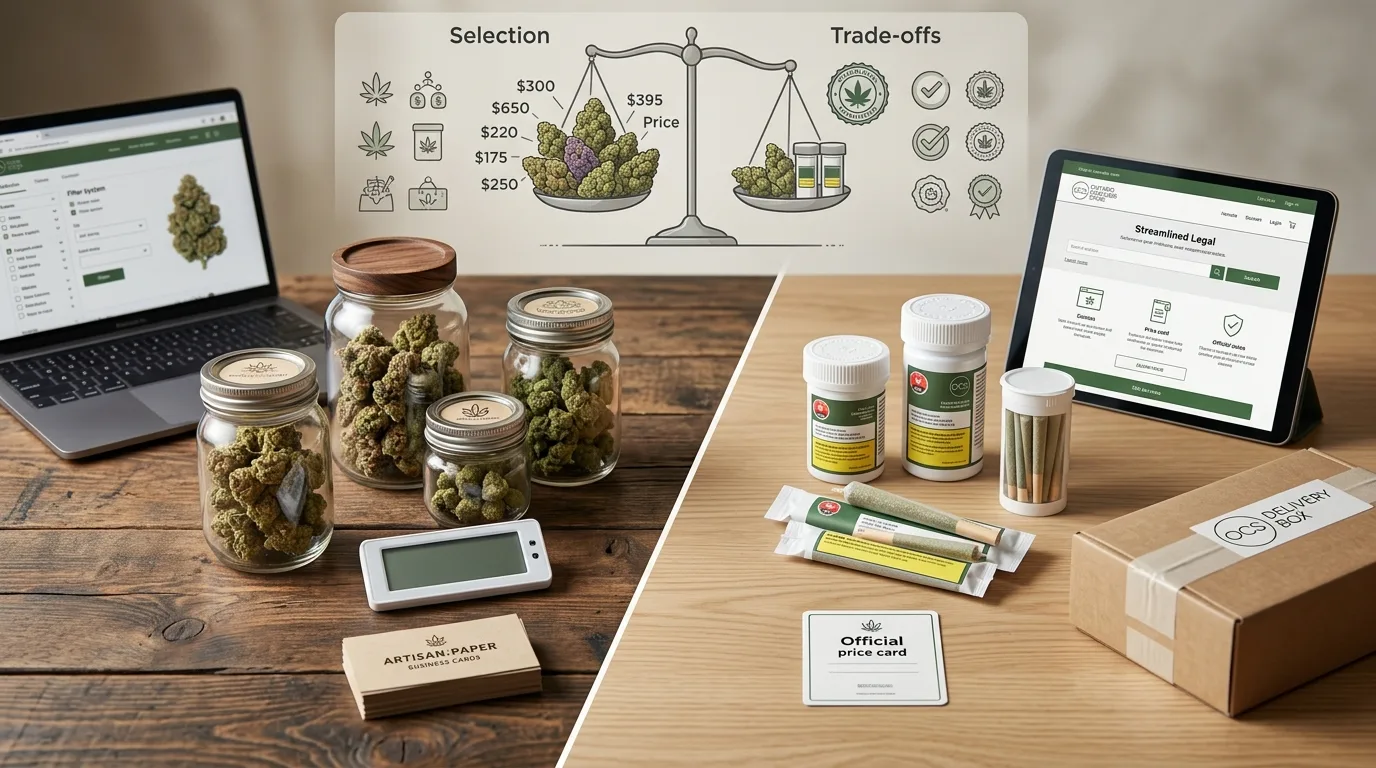
If you're shopping for cannabis in Ontario, you've probably noticed two distinct options: the government-run Ontario Cannabis Store (OCS) and private online dispensaries. Both deliver to your door, both carry flower, edibles, concentrates, and vapes,but the shopping experience, pricing structure, and product selection differ dramatically. Understanding these differences can save you money, expand your options, and help you find the right fit for your consumption habits.
The OCS launched in 2018 as Ontario's legal online cannabis retailer, controlling the wholesale supply chain and setting the framework for the province's cannabis market. Private online dispensaries, meanwhile, operate through mail-order models that prioritize bulk pricing, craft cannabis, and product diversity. Both serve Toronto, Ottawa, and communities across Ontario, but their business models create fundamentally different value propositions. This guide breaks down pricing, selection, quality grades, shipping timelines, and the practical trade-offs every Ontario cannabis consumer should understand before placing their next order.
How Pricing Works: Why OCS and Private Dispensaries Charge Different Amounts
The price gap between OCS and private online dispensaries stems from structural differences in how cannabis reaches your door. OCS operates within Ontario's regulated retail framework, sourcing products exclusively from federally licenced producers approved by Health Canada. This supply chain includes excise taxes (which account for roughly $1 per gram or 10% of the sale price, whichever is higher), wholesale markups, and retail margins built into every purchase.
Private online dispensaries typically source from craft growers, small-batch producers, and import channels that bypass the traditional licenced producer network. Without the same regulatory overhead, these operations can offer lower base prices,especially on bulk quantities. A quarter-ounce (7 grams) of quality flower might cost $45-$60 on OCS, while the same grade from a private dispensary often lands between $30-$50. The difference becomes more pronounced at larger volumes: an ounce from OCS averages $140-$220 depending on strain and brand, whereas private dispensaries frequently offer ounce deals starting around $95.
Understanding Grade-Based Pricing Models
OCS products don't use traditional AA/AAA/AAAA grading systems,instead, they categorize by brand, THC percentage, and licenced producer reputation. You'll see budget brands like Original Stash and Shred competing with premium offerings from Broken Coast or Simply Bare, but the pricing doesn't always correlate with quality in the way experienced consumers expect. A 20% THC indica from a mid-tier LP might cost the same as a meticulously cured 18% craft strain, leaving buyers to rely on brand recognition rather than transparent grading.
Private dispensaries, conversely, have adopted the AA-AAAAA+ grading framework that originated in British Columbia's legacy market. This system evaluates bud structure, trichome density, cure quality, and terpene preservation,not just THC numbers. Budget AA flower typically runs $60-$80 per ounce, solid AAA sits around $95-$140, quad AAAA hits $160-$200, and top-shelf AAAAA+ can reach $220-$280. This tiered approach lets consumers make informed price-versus-quality decisions based on consistent standards. Our Toronto price guide breaks down what each grade actually delivers so you know exactly what to expect at every tier.
Excise Tax and Legal Compliance Costs
Every legal cannabis purchase in Canada includes federal excise tax, calculated as the greater of $1 per gram or 10% of the producer's sale price. For a $30 eighth (3.5g), that's $3.50 in excise duty before provincial sales tax. OCS retail prices reflect these taxes transparently, along with provincial markup that helps fund Ontario's cannabis regulation infrastructure. You're paying for lab testing, child-resistant packaging, track-and-trace systems, and regulatory compliance at every step.
Private online dispensaries operate outside this taxation framework, which explains part of their pricing advantage. While this creates savings for consumers, it also means these purchases don't contribute to the legal market's quality assurance systems. The trade-off is lower prices in exchange for self-directed quality evaluation,you're relying on vendor reputation and product photos rather than government-mandated lab certificates.
Selection: Where Variety and Availability Differ
Walk through OCS's digital catalogueue and you'll find approximately 2,000-3,000 active SKUs spanning flower, pre-rolls, vapes, edibles, concentrates, topicals, and accessories. This represents products from roughly 100+ licenced producers, each meeting Health Canada's Good Production Practices standards. The selection prioritizes compliance and consistency: every batch undergoes testing for potency, pesticides, heavy metals, and microbial contamination. You'll find mainstream brands like Aurora, Canopy Growth, and Aphria alongside newer craft entries, but product turnover can be slow and regional favourites sometimes disappear without warning.
Private online dispensaries curate smaller but often more dynamic inventories,typically 200-600 products with heavy emphasis on flower, concentrates, and edibles. The focus shifts toward unique genetics, small-batch hash, import concentrates, and high-potency edibles that exceed OCS's 10mg THC-per-package limit. You're more likely to find rare strains like Black Truffle, Pink Death Breath, or Astro Warrior that never appear on legal shelves. The catalogueue rotates based on harvest cycles and supplier availability, creating a more curated, sometimes unpredictable shopping experience.
Edibles and Potency Limits
OCS edibles face strict Health Canada regulations: no package can contain more than 10mg of THC, regardless of format. This means high-tolerance users need to purchase multiple packages to achieve desired effects,a $6-$12 expenditure for what amounts to a single serving for experienced consumers. Gummies, chocolates, baked goods, and beverages all adhere to this limit, making cost-per-milligram calculations essential for budget-conscious shoppers.
Private dispensaries offer edibles in formats OCS cannot legally sell: 500mg gummies, 1,000mg chocolate bars, and multi-thousand milligram packages designed for tolerance-heavy users. A 3,000mg edible package might cost $30-$45, delivering 30-45 times the THC of a legal alternative at a fraction of the per-milligram cost. Products like ultra-high-dose edibles serve medical patients, experienced users, and anyone seeking maximum value per dollar spent. The trade-off is lack of standardized testing,you're trusting the vendor's dosing accuracy rather than lab-verified potency.
Concentrates, Hash and Imports
OCS carries a growing concentrate selection including shatter, live resin, rosin, distillate, and hash from licenced producers. Prices typically range from $25-$70 per gram depending on format and brand, with potency hovering between 70-95% THC. The quality can be excellent,brands like BIG produce solid live resin, and Greybeard offers premium hash rosin,but selection pales compared to legacy market diversity.
Private dispensaries stock traditional import hash varieties rarely (if ever) seen through legal channels: Moroccan blonde, Afghan black, Lebanese red, and Pakistani finger hash sourced through established import networks. These products carry cultural and historical significance beyond mere potency, offering flavour profiles and textures impossible to replicate with modern extraction methods. Domestic concentrates also trend toward craft producers using small-batch, strain-specific material rather than large-scale commercial trim runs. Pricing often undercuts OCS by 30-50% while delivering comparable or superior quality.
Quality Assurance: Testing, Standards and What You're Actually Getting
OCS products benefit from mandatory third-party labouratory testing conducted by Health Canada-approved facilities. Every batch undergoes analysis for cannabinoid content (THC, CBD, CBN), terpene profiles, pesticide residues, heavy metals, microbial contamination, and mycotoxins. Results must fall within acceptable ranges before products receive approval for sale, and lot numbers allow for precise tracking if issues arise. This testing infrastructure costs money,expenses ultimately passed to consumers,but provides genuine peace of mind regarding safety and potency accuracy.
Private online dispensaries rely on vendor reputation, visual inspection, and community feedback rather than standardized lab testing. Reputable operations maintain quality through careful sourcing,establishing relationships with trusted growers, visually grading product, and sampling batches before listing. Customer reviews function as distributed quality control: popular strains with positive feedback indicate consistent quality, while complaints trigger delisting or supplier changes. This system works surprisingly well within communities that prioritize transparency, but it requires consumers to research vendors and interpret feedback rather than relying on third-party certification.
Pesticide and Contamination Concerns
Health Canada's cannabis testing standards prohibit 96 specific pesticides and establish maximum residue limits for approved pest control products. Licenced producers face potential licence suspension or product recalls if contamination appears, creating strong incentives for clean cultivation. OCS customers can purchase with confidence that their flower hasn't been treated with banned chemicals or grown in contaminated environments.
Private market cannabis lacks this regulatory oversight, placing responsibility on individual growers and vendors. Established dispensaries typically source from producers with clean cultivation practices,organic growing methods, integrated pest management, and quality-focused approaches,but verification depends on vendor integrity. First-time buyers should stick with well-reviewed vendors, ask questions about sourcing, and watch for warning signs like harsh smoke, chemical tastes, or unusually cheap pricing that might indicate substandard material.
Moisture Content and Cure Quality
A persistent complaint about OCS cannabis centres on dryness: flower that arrives over-dried, crumbles to dust, and burns harshly due to extended storage in distribution warehouses. The legal supply chain's complexity,producer to distributor to retailer to consumer,means weeks or months can pass between packaging and consumption. Humidity packs help, but many legal products require rehydration before they smoke smoothly.
Private dispensaries often ship fresher product because they operate with shorter supply chains and faster inventory turnover. Craft growers package material within days or weeks of harvest, and popular strains sell quickly rather than languishing in warehouses. The result is flower that retains moisture, terpenes, and freshness more reliably than many legal alternatives. Proper storage remains essential regardless of source, but starting with properly cured, fresh cannabis makes a noticeable difference in flavour and smoke quality.
Shipping, Delivery and Access Across Ontario
OCS ships via Canada Post to every address in Ontario, typically delivering within 2-5 business days to major centres and 3-7 days to remote areas. Shipping costs $5 for standard delivery on orders under $50, with free shipping on orders exceeding that threshold. Packages arrive in plain, unmarked boxes with no cannabis-related branding,discretion guaranteed. Canada Post requires signature on delivery and age verification (19+), meaning someone must be home to receive the package or arrange pickup at a local post office.
Private online dispensaries use similar Canada Post shipping but often include expedited options like Xpresspost (1-2 business days) or priority overnight for time-sensitive orders. Shipping costs vary by vendor and order size: some offer free shipping on orders over $100-$150, while others charge flat rates of $10-$20 regardless of order size. Tracking numbers arrive via email within 24 hours of order placement, and packages ship in discreet packaging identical to any other mail-order product. Understanding shipping timelines and coverage areas helps set realistic expectations regardless of which vendor you choose.
Same-Day vs Standard Shipping
OCS does not offer same-day delivery,even Toronto residents wait at least 1-2 business days for Canada Post transit. This limitation makes OCS impractical for urgent needs or last-minute purchases. The trade-off is predictable, reliable service backed by Canada's national postal infrastructure.
Some private dispensaries in Toronto operate courier networks offering same-day delivery within the GTA, though this typically applies to physical storefronts rather than mail-order operations. Mail-order services prioritize next-day or two-day shipping via Xpresspost, splitting the difference between instant gratification and extended wait times. For regular consumers who plan purchases in advance, standard shipping works fine; for spontaneous buyers, same-day courier services (where available) provide faster access.
Rural and Remote Access
OCS delivers everywhere Canada Post reaches, making it the most reliable option for rural and remote Ontario communities. Northern towns, cottage country, and areas far from physical dispensaries receive the same service as downtown Toronto,just with slightly longer transit times. This universal access represents one of OCS's strongest advantages: no minimum order requirements, no geographic restrictions, and guaranteed delivery regardless of location.
Private dispensaries ship nationwide but may impose minimum order requirements ($50-$100) that make small purchases uneconomical once shipping costs factor in. Rural buyers often find better value ordering larger quantities less frequently rather than placing multiple small orders with shipping fees attached each time. Bulk ounce deals make particular sense for remote consumers who want to minimize shipping frequency while maximizing value.
Payment Methods and Transaction Security
OCS accepts major credit cards (Visa, Mastercard, American Express), debit cards via Interac Online, and prepaid Visa/Mastercard gift cards. Transactions process through secure, PCI-compliant payment gateways with encryption protecting financial data. Your bank statement shows charges from "OCS" or "Ontario Cannabis Store," making purchases easily identifiable but potentially visible to anyone with account access. The payment experience mirrors any mainstream e-commerce platform: enter card details, confirm purchase, receive email confirmation.
Private online dispensaries face banking restrictions that prevent traditional credit card processing,most major financial institutions refuse to work with cannabis businesses due to federal banking regulations (Canada's legal framework notwithstanding). As a result, these vendors rely on Interac e-Transfer, cryptocurrency (Bitcoin, Ethereum), or cash-on-delivery in some markets. E-Transfer dominates as the most common payment method: buyers send funds to a specified email address, include order number in the message field, and vendors ship upon payment confirmation. This adds 24-48 hours to processing time but maintains transaction privacy,your bank statement shows generic e-Transfers rather than cannabis-related charges.
Privacy and Financial Discretion
OCS purchases create digital paper trails: credit card statements, email confirmations, and account order histories all document your cannabis consumption. For most buyers this poses no concern, but individuals in sensitive employment situations, shared financial accounts, or privacy-conscious households may prefer alternative payment methods.
Interac e-Transfer payments to private dispensaries appear as generic person-to-person transfers on bank statements,no cannabis-related merchant names, no identifying details. Combined with discreet shipping and minimal data collection, this approach maximizes financial privacy. Cryptocurrency payments take this further, offering near-complete anonymity, though they require technical knowledge and acceptance of price volatility. The privacy advantage comes with trade-offs: e-Transfers offer no chargeback protection if disputes arise, placing more trust in vendor reliability.
Legal Status and Risk Considerations
OCS operates as Ontario's legal cannabis retailer under the Cannabis Licence Act and federal Cannabis Act. Every purchase supports the regulated market, contributes tax revenue to public services, and carries zero legal risk for consumers. Police cannot charge you for possessing cannabis purchased from OCS, and employment-related consequences (outside safety-sensitive positions) generally don't apply to legal purchases. The legal framework protects consumers while establishing quality and safety standards that minimize health risks.
Private online dispensaries exist in regulatory grey areas. While cannabis possession remains legal for adults in Canada, purchasing from unlicensed sources technically violates federal law,though enforcement focuses on sellers rather than buyers. In practical terms, consumers face minimal legal risk: police rarely (if ever) pursue charges against individuals purchasing small quantities for personal use, and prosecution would require proving the source of purchased cannabis. That said, the legal ambiguity means no regulatory protections apply if product quality issues, shipping problems, or vendor disputes arise.
Employment and Insurance Considerations
Safety-sensitive industries (transportation, construction, healthcare) often maintain drug testing policies that treat cannabis use as grounds for termination or discipline. Legal purchase from OCS doesn't protect employees in these sectors,the employment relationship governs, not cannabis's legal status. However, recreational users in non-safety-sensitive roles generally face no professional consequences from legal cannabis purchases.
Life insurance, disability insurance, and certain mortgage applications sometimes include questions about cannabis consumption or require medical examinations that might detect use. Legal purchases from OCS establish a documented consumption history that could potentially affect underwriting decisions, though disclosure requirements vary by insurer and policy type. Private dispensary purchases, lacking documentation, maintain greater privacy but offer no recourse if coverage disputes arise. The intersection of cannabis legalization and insurance regulation remains evolving,consult with insurance professionals regarding specific policy implications.
Product Liability and Consumer Recourse
If contaminated or mislabeled OCS cannabis causes harm, Ontario's consumer protection framework provides legal recourse. You can pursue refunds, file complaints with the Alcohol and Gaming Commission of Ontario, or initiate legal action against licenced producers under product liability law. The regulatory system creates accountability mechanisms protecting consumer interests.
Private dispensary purchases offer no such protections. If product quality disappoints, shipping goes missing, or vendor disputes arise, you rely entirely on the seller's customer service policies. Reputable vendors maintain strong reputations by resolving issues promptly,replacing lost shipments, offering refunds for quality concerns, and maintaining responsive support channels,but no regulatory body enforces these practices. Choose vendors with established track records and positive community feedback to minimize risk.
The Value Equation: When Each Option Makes Most Sense
OCS delivers maximum value for consumers who prioritize legal compliance, verified product testing, and predictable quality over absolute lowest prices. First-time cannabis users, medical patients requiring specific cannabinoid ratios, and anyone uncomfortable with grey-market purchases should default to OCS. The regulatory framework ensures safety, consistency, and legal protection that justify modest price premiums,especially for smaller quantities where bulk pricing advantages matter less.
Private online dispensaries offer superior value for experienced consumers purchasing regularly, seeking specific strains or formats unavailable through legal channels, or buying in quantities where bulk pricing creates substantial savings. If you consume an ounce monthly, the $50-$100 price difference between OCS and private options adds up to $600-$1,200 annually,enough to justify the minimal legal ambiguity for most users. Concentrate enthusiasts, high-dose edible consumers, and anyone seeking import hash or craft genetics will find dramatically better selection and pricing outside the legal framework.
Hybrid Approaches and Strategic Shopping
Many experienced Ontario cannabis consumers use both channels strategically: OCS for products that benefit from legal testing (edibles, vapes, beverages) and private dispensaries for flower, hash, and bulk purchases where value matters most. This hybrid approach balances legal compliance for higher-risk product categories while capturing savings on commoditized items like flower. You might buy vape cartridges from OCS (where potency accuracy and hardware safety matter) while sourcing ounces from private vendors (where savings justify minimal risk).
Seasonal considerations also influence choice: stocking up through private dispensaries during sales or bulk promotions, then supplementing with OCS purchases when trying new products or formats. The flexibility to move between channels based on current needs, budget constraints, and product availability creates optimal outcomes for informed consumers who understand each system's strengths and limitations.
Explore Our Selection
Browse Toronto's best selection of AAAA+ flower, import hash, and high-potency edibles with fast, discreet shipping across Ontario.
Shop NowFrequently Asked Questions
Purchasing from unlicensed sources technically violates federal law, but enforcement targets sellers rather than consumers. Individuals buying for personal use face minimal practical legal risk, though no regulatory protections apply if issues arise. OCS remains the only fully legal option, while private dispensaries operate in grey areas with higher value but lower legal certainty.
Private dispensaries avoid excise taxes, regulatory compliance costs, and licenced producer markups that add $30-$80 per ounce to OCS pricing. Shorter supply chains, direct relationships with growers, and bulk-focused business models create additional savings passed to consumers. The trade-off is lack of mandatory lab testing and regulatory oversight that OCS provides.
OCS accepts returns within 14 days for unopened, sealed products with proof of purchase, though opened cannabis cannot be returned due to health regulations. Private dispensaries vary,reputable vendors replace defective products or offer store credit for quality issues, but policies depend entirely on individual vendor terms. Always check return policies before purchasing.
Research vendor reputation through community forums, review sites, and social media feedback. Look for established operations with detailed product photos, responsive customer service, secure payment processing, and transparent shipping policies. Start with small orders to test quality and service before committing to bulk purchases. Avoid vendors with no online presence, unclear contact information, or suspiciously low prices.
Cannabis doesn't expire in the food safety sense, but potency and quality degrade over time,especially in over-dried flower. OCS packaging dates help identify fresh product, though warehouse storage can mean months between packaging and purchase. Proper storage in airtight containers with humidity control extends shelf life significantly regardless of source.
OCS shipments lost by Canada Post qualify for refunds or replacements through customer service. Private dispensary policies vary: many reship lost packages once or offer partial refunds, while others consider delivery complete once tracking shows shipment. Seizures are extremely rare for personal-quantity orders shipped domestically,both OCS and private vendors use discreet packaging that gives no indication of contents.
Making the Right Choice for Your Situation
The OCS versus private online dispensary decision ultimately comes down to what you value most: legal certainty and lab-tested products, or selection diversity and substantial cost savings. Neither option is objectively superior,each serves different consumer priorities within Ontario's complex cannabis landscape. OCS provides peace of mind for buyers who want government backing, verified testing, and maximum legal protection. Private dispensaries deliver value for experienced consumers who prioritize pricing, selection, and craft quality over regulatory oversight.
Most Ontario cannabis consumers eventually develop purchasing patterns that leverage both systems strategically. You might rely on OCS for products where testing matters most,vapes, edibles, beverages,while sourcing flower and concentrates from private vendors where bulk pricing creates meaningful savings. As you gain experience with different strains, formats, and vendors, you'll develop preferences based on your consumption patterns, budget, and risk tolerance.