You're standing in front of your stash box with a simple question: gummy or joint? The choice between edibles and smoking cannabis isn't just about preference,it's about timing, intensity, and what you're trying to accomplish. A five-minute smoke break delivers completely different results than a 100mg brownie, and understanding these differences can mean the gap between a perfectly calibrated experience and an unexpectedly intense evening on your couch.
Both methods get THC into your system, but the journey it takes,and how your body processes it,creates fundamentally different experiences. Whether you need fast relief that fades quickly or sustained effects that last through a long flight, knowing how onset times and duration patterns work gives you actual control over your cannabis consumption. This guide breaks down the science, the timelines, and the real-world scenarios where each method shines.
How Your Body Processes Edibles vs Smoke: The Metabolic Difference
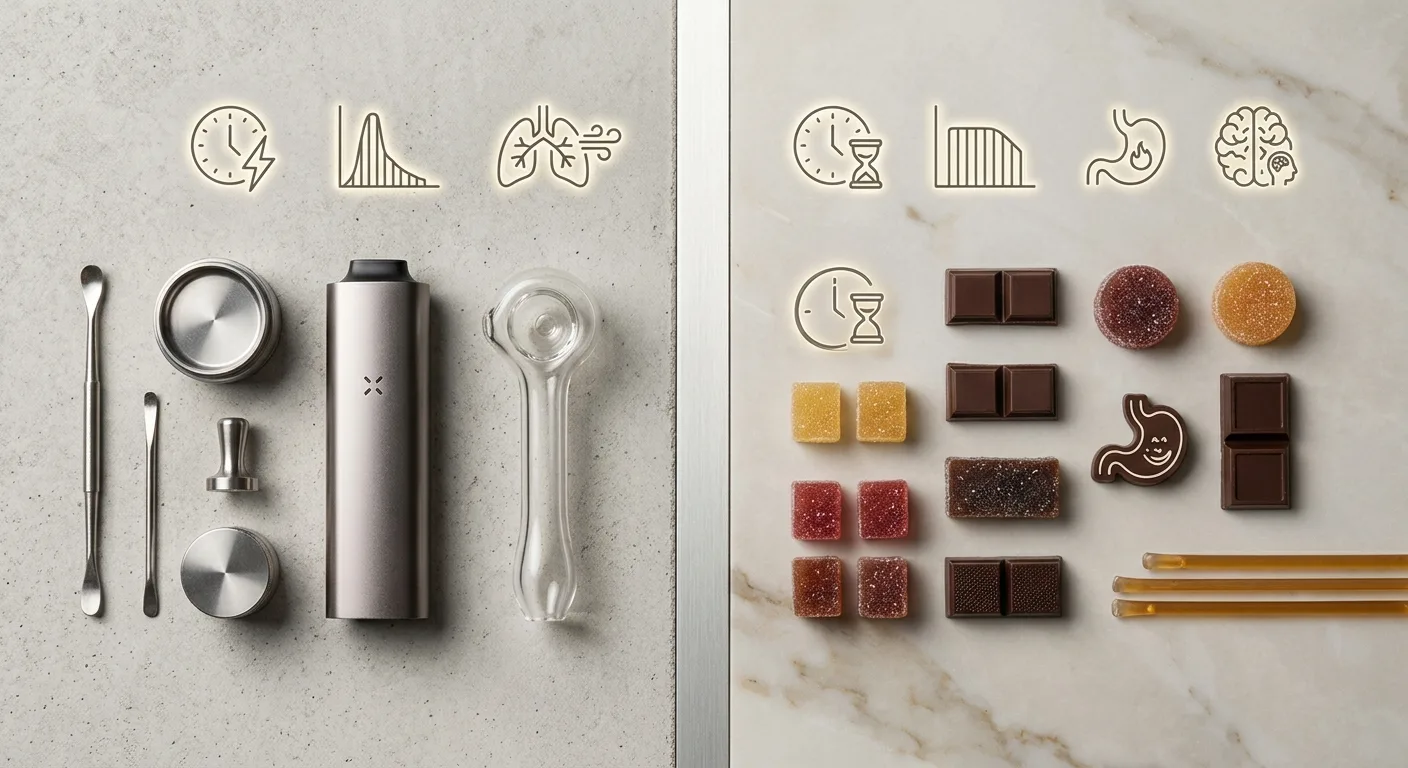
The route THC takes through your body determines everything about your experience. When you smoke or vape cannabis, THC enters your lungs and passes directly into your bloodstream through tiny air sacs called alveoli. Within seconds, it crosses the blood-brain barrier and binds to cannabinoid receptors. This is why you feel effects in 2-10 minutes,there's no metabolic detour, just a straight shot from lungs to brain.
Edibles take a completely different path. When you swallow a gummy or brownie, THC travels through your digestive system to your liver before entering general circulation. Your liver converts delta-9-THC (the compound in cannabis) into 11-hydroxy-THC, a metabolite that's actually more potent and crosses the blood-brain barrier more efficiently than the original molecule. This liver conversion is why edibles feel different,you're not just getting THC, you're getting a supercharged version of it.
This metabolic process explains the delayed onset. Your stomach needs to break down the edible, your intestines must absorb the THC, and your liver has to perform its conversion work. Depending on what you've eaten that day, your metabolism, and the type of edible, this process takes anywhere from 30 minutes to 2 hours. Some people with faster metabolisms report feeling effects in 20 minutes, while others with slower digestion or a full stomach might wait 90 minutes or longer.
First-Pass Metabolism and Bioavailability
Here's where it gets technical but important: smoking has higher bioavailability than edibles. When you smoke, roughly 10-35% of available THC enters your bloodstream (the range depends on how deeply you inhale and hold). With edibles, only 4-12% makes it past what's called first-pass metabolism,the liver's filtering process that breaks down substances before they reach systemic circulation.
This lower bioavailability doesn't mean edibles are weaker. That 11-hydroxy-THC is potent enough that even smaller amounts create powerful, long-lasting effects. It does mean dosing works differently. A 10mg edible won't feel equivalent to smoking a 10mg joint, even though the THC content looks identical on paper.
Onset Times: When Effects Actually Start
Timing is everything when you're trying to manage pain before bed, enhance a concert experience, or simply unwind after work. The onset window for smoking versus edibles creates completely different use cases, and understanding these timelines prevents both underwhelming experiences and accidental overconsumption.
Smoking and Vaping: The 2-10 Minute Window
Inhalation methods deliver the fastest onset in cannabis consumption. Most users report initial effects within 2-5 minutes of their first puff, with peak intensity hitting around 10-20 minutes. This rapid onset gives you immediate feedback,you know within minutes whether you've had enough or need another toke. For experienced users, this control is invaluable for dialing in exactly the right level.
The speed comes from surface area. Your lungs contain roughly 300 million alveoli, creating about 70 square metres of absorption surface,roughly the size of a tennis court. THC molecules diffuse across this massive interface almost instantly, which is why one good hit can shift your headspace before you've finished exhaling.
Edibles: The 30-120 Minute Delay
Edible onset depends on multiple factors beyond just THC content. An empty stomach can speed absorption to 30-45 minutes, while a heavy meal might push onset past 90 minutes. The type of edible matters too. Hard candies and lozenges that dissolve in your mouth offer some sublingual absorption, potentially cutting onset to 15-30 minutes. Baked goods, chocolates, and gummies that you swallow whole take longer,your stomach acid needs to break them down first.
Fat content influences absorption speed as well. THC is fat-soluble, so edibles made with butter, oil, or chocolate might absorb more efficiently than fat-free options. Some users report that taking edibles with a small fatty snack (like peanut butter or cheese) helps speed onset by 10-15 minutes, though this remains largely anecdotal rather than scientifically proven.
The most common mistake with edibles? Impatience. Someone takes a 20mg gummy, feels nothing after 45 minutes, and takes another. Then both hit simultaneously at the 75-minute mark, delivering 40mg at once,far more than intended. This is why understanding proper edible dosing based on your tolerance and timing expectations prevents uncomfortable experiences.
Duration: How Long Effects Last
If onset timing determines when your experience starts, duration dictates how long you're committing. This is where edibles and smoking diverge most dramatically, and where choosing the wrong method for your schedule can create real problems,like being unexpectedly high during a video call or wearing off too soon during a long event.
Smoking Duration: 1-3 Hour Window
The same rapid onset that makes smoking attractive also means faster clearance. Most users report peak effects lasting 30-60 minutes, with residual effects tapering off over the next 1-2 hours. Total duration from first puff to baseline typically runs 2-3 hours for most consumers, though heavy doses or concentrated products might extend this to 4 hours.
This shorter duration creates natural use patterns. Many people who smoke medicinally dose multiple times throughout the day,a morning session for anxiety, an afternoon puff for pain, an evening joint for sleep. The short-acting nature means you're not committed to being high for half the day from one consumption event.
Edible Duration: 4-12 Hour Commitment
When that 11-hydroxy-THC hits your system, it settles in for the long haul. Most edible experiences last 4-6 hours at moderate doses (10-25mg for average consumers), with peak intensity between 2-4 hours after onset. Higher doses can extend effects to 8 hours or more, and some users report subtle residual effects lasting 12+ hours with very high doses (100mg+).
This extended duration makes edibles ideal for situations where you want sustained effects without repeated dosing. Chronic pain patients often prefer nighttime edibles that provide relief through the entire sleep cycle. Long flights or road trips (as a passenger, obviously) suit edibles better than multiple smoke sessions. But that same duration becomes a liability if you need to be functional on short notice,you can't simply "sober up" from an edible the way effects fade with smoking.
Why the Duration Difference Matters
The duration gap stems from continuous absorption and slow metabolite clearance. When you smoke, you get one concentrated bolus of THC that your body processes and eliminates relatively quickly. With edibles, absorption continues for hours as your digestive system breaks down the product. Your liver keeps converting THC to 11-hydroxy-THC in waves, and that metabolite clears more slowly than regular THC.
This creates what users describe as "waves" of edible effects. You might feel intense at hour 2, slightly less at hour 3, then experience a second surge at hour 4 as another portion of the edible digests. Smoking delivers a cleaner arc,up fast, peak briefly, down steadily.
Intensity and Experience Quality: Beyond Just "Getting High"
Ask someone to describe an edible high versus a smoking high, and you'll get surprisingly consistent answers: edibles feel more "body-focused," "sedating," or "psychedelic," while smoking feels more "cerebral," "manageable," or "functional." These aren't just subjective impressions,the different cannabinoid profiles and metabolites create genuinely distinct experiences.
The Edible Experience: Full-Body and Immersive
That 11-hydroxy-THC we keep mentioning creates what users describe as a more complete body high. Many report stronger physical sensations,heaviness in limbs, deep muscle relaxation, enhanced tactile perception. The experience tends toward sedation and introspection rather than social energy. This makes edibles particularly effective for pain management, sleep, or situations where you want deep relaxation.
The intensity curve with edibles also feels different. Because onset is gradual and peak effects can take 2-3 hours to fully develop, you're riding a slow escalator rather than a quick elevator. Some users find this gentler approach more comfortable, while others prefer the immediate feedback of smoking. However, once you're at peak intensity with edibles, you're locked in,there's no "smoking less of the joint" to moderate effects mid-experience.
The Smoking Experience: Cerebral and Controllable
Smoking tends to produce what users call a "headier" high,more focused in mental effects like euphoria, creativity, altered perception, and social energy. The physical relaxation is still there but typically feels secondary to the mental shift. This makes smoking preferable for social situations, creative work, or activities where you want to remain relatively functional.
The controllability factor can't be overstated. With smoking, you can take one puff, wait five minutes, assess how you feel, and decide whether to continue. This titration ability makes it much easier to find your sweet spot, especially if you're trying a new strain or cannabis type for the first time. You're the pilot making real-time adjustments rather than a passenger on a pre-set course.
Practical Situations: Which Method Fits Your Needs
Theory is helpful, but real decisions happen in context. Should you smoke before the concert or take an edible? Gummy before the flight or vape pen? The "right" answer depends entirely on your timeline, setting, and what you're trying to accomplish. Here's how to match method to situation.
When Smoking Makes More Sense
Quick relief situations: Acute anxiety, sudden nausea, unexpected pain flare-ups,anything requiring fast onset benefits from inhalation. If you need effects in 5 minutes, edibles simply can't deliver. This includes situations where you need to time effects precisely, like taking the edge off before a stressful phone call or managing pre-event jitters with a small window before you need to function.
Social and public settings: Despite increasing normalization, most social situations favour the discrete, fast-acting nature of smoking (especially vaping). A vape pen in a bathroom takes 30 seconds and delivers immediate effects. An edible requires planning 60-90 minutes ahead and commits you to hours of effects you can't control. For concerts, parties, or events, many users prefer the flexibility of smoking.
Dose titration and testing: Trying a new strain? Start by smoking it. You'll know within 10 minutes if it's too sedating, too anxious, too weak, or just right. This feedback loop makes smoking the superior choice when you're experimenting or establishing tolerance with unfamiliar products. Once you know how something affects you, you can consider edible versions.
Daytime functionality: If you need to potentially sober up for an unexpected call, meeting, or responsibility, smoking's shorter duration provides more flexibility. While you can't actually accelerate cannabis clearance, the natural 2-3 hour window means you're working with predictable timelines rather than committing to 6+ hours of altered state.
When Edibles Are the Better Choice
Extended relief needs: Chronic pain that wakes you up at 3am, all-day inflammation, sustained nausea from medical treatments,these conditions benefit from edibles' long duration. One nighttime dose can provide 6-8 hours of relief without repeated smoking sessions. Many medical users prefer edibles specifically for this sustained coverage.
Respiratory considerations: Anyone with asthma, chronic bronchitis, lung sensitivity, or simply a preference to avoid smoke benefits from edibles. While vaping is less harsh than combustion, it still irritates some users. Edibles provide zero respiratory impact, making them the obvious choice for anyone with lung concerns.
Discreet consumption: Despite vaping's minimal odour, edibles remain the most discrete consumption method. No smell, no visible vapour, no paraphernalia,just you eating what appears to be normal candy or chocolate. For people in living situations where they can't smoke (apartments, family homes, dorms), edibles offer complete privacy. This is also why many people prefer edibles when ordering online and storing at home.
Sleep optimization: The extended duration and body-focused effects make edibles superior for sleep. Taking an edible 60-90 minutes before bed means you're hitting peak effects right as you're trying to fall asleep, and the 6-8 hour duration carries through most of the night. Smoking before bed works, but the effects often wear off 2-3 hours into sleep, potentially causing middle-of-the-night waking.
Hybrid Approaches: Using Both Strategically
The most sophisticated users don't choose one method over the other,they use both strategically. A common pattern: take an edible 60 minutes before an event for sustained effects, then smoke or vape for immediate boosts or adjustments throughout. This "layering" approach gives you the duration of edibles with the controllability of smoking.
Another pattern: edibles for baseline, smoking for breakthrough. Medical users might maintain consistent low-level relief with a small daily edible dose (5-10mg), then smoke as needed for acute symptom spikes. This minimizes total smoke inhalation while maintaining flexible relief options.
Dosing Differences: Why 10mg Isn't Always 10mg
Here's where things get confusing: a 10mg edible doesn't feel equivalent to smoking 10mg of THC, even though the cannabinoid content is identical. The different metabolic pathways, bioavailability rates, and compound conversions mean you need to think about dosing completely differently for each method.
Smoking Dosage Guidelines
Most pre-rolled joints contain 0.5-1g of flower at 15-25% THC, delivering roughly 75-250mg of total THC. But remember that bioavailability,you're only absorbing 10-35% of that. A strong joint might deliver 30-80mg of active THC to your bloodstream, but you're consuming it gradually over 5-10 minutes of smoking, giving you continuous feedback and control.
For most regular users, 2-3 good hits from a joint or vape provides sufficient effects. New users might feel substantial effects from a single hit. The key advantage: you can always smoke more, but you can't smoke less once you've inhaled. This built-in safety mechanism makes smoking more forgiving for beginners despite the higher total THC content in most flower products.
Edible Dosage Guidelines
Standard dosing recommendations for edibles typically start at 2.5-5mg for new users, 5-15mg for occasional users, 15-30mg for regular users, and 30mg+ for experienced consumers with established tolerance. These numbers are dramatically lower than smoking doses because of that potent 11-hydroxy-THC conversion. A 10mg edible might feel equivalent to smoking 30-40mg worth of flower for many users.
The problem? Edible tolerance varies wildly between individuals. Some people have liver enzyme profiles that convert THC more efficiently, making them extremely sensitive to edibles. Others have genetic variations that reduce conversion, requiring much higher doses to feel effects. This genetic lottery means you can't reliably predict your edible dose based on your smoking tolerance.
If you're transitioning from smoking to edibles, start conservatively,probably 5-10mg even if you smoke daily. Wait a full 2 hours before considering taking more. Many users who "don't feel edibles" simply haven't waited long enough for onset or haven't found their minimum effective dose through systematic testing. If you're looking for higher-dose edible options, products like the Galaxy Gummies 6000mg offer potent choices for experienced users.
Cross-Tolerance Considerations
Regular smoking builds tolerance to THC, but this tolerance doesn't fully cross over to edibles because you're building tolerance to delta-9-THC while edibles primarily deliver 11-hydroxy-THC. Someone with massive smoking tolerance might find edibles disproportionately strong, while daily edible users sometimes report smoking feels less intense than expected. The cannabinoid receptor desensitization overlaps, but the specific compound differences create asymmetric tolerance patterns.
Health and Safety: Comparing Risks
No consumption method is risk-free, but the risk profiles differ substantially between smoking and edibles. Understanding these differences helps you make informed choices about your preferred consumption method and how to mitigate potential downsides.
Respiratory Impact of Smoking
The primary health concern with smoking cannabis is respiratory irritation. Combustion produces tar, particulates, and carbon monoxide regardless of what you're burning. Regular cannabis smokers show increased cough, phlegm production, and bronchitis symptoms similar to tobacco smokers, though notably without the same lung cancer correlation (possibly due to anti-inflammatory cannabinoids offsetting some carcinogenic effects).
Vaping reduces but doesn't eliminate respiratory concerns. While it avoids combustion byproducts, heated vapour still irritates sensitive lung tissue. For anyone with existing respiratory conditions,asthma, COPD, chronic bronchitis,inhalation methods present genuine health risks that edibles completely avoid.
Overconsumption Risk with Edibles
The primary safety concern with edibles isn't long-term health damage but acute overconsumption. That delayed onset creates a dangerous window where users feel nothing, assume the edible was weak, and take more,only to have all doses hit simultaneously. Cannabis overconsumption isn't physically dangerous (there's no lethal dose for THC), but it's psychologically extremely uncomfortable: intense anxiety, paranoia, nausea, and in extreme cases, hallucinations or vomiting.
Emergency room visits related to cannabis have increased in legal markets, with edibles driving much of that increase. Most cases involve tourists or inexperienced users taking excessive doses. The experience is temporary,even massive doses clear within 12-24 hours,but those hours can be genuinely distressing. This is why conservative dosing and patience are non-negotiable with edibles.
Digestive and Caloric Considerations
Edibles add calories to your day, which matters if you're consuming them regularly. A 100mg chocolate bar might contain 200-300 calories of sugar and fat. Gummies are often high in sugar. For daily medical users, these calories add up. Smoking and vaping have zero caloric impact.
Some users also report digestive discomfort from edibles, particularly products made with coconut oil or MCT oil, which can cause stomach upset in sensitive individuals. The sugar content in many edibles can be problematic for diabetics or anyone managing blood sugar. These are minor concerns for occasional users but worth considering for daily consumption patterns.
Cost Comparison: Which Offers Better Value
The economics of smoking versus edibles depend entirely on how you measure value. Are you optimizing for THC per dollar? Duration of effects? Total experiences per purchase? The answer shifts depending on your priorities.
Flower typically ranges from $3-12 per gram in Toronto's market, with quality tiers dramatically affecting price. An ounce at $95 from bulk deals breaks down to about $3.40 per gram,roughly $1.70 per 0.5g joint. At 20% THC, that's 100mg THC per joint, or about 1.7 cents per milligram of THC. Premium AAAA+ flower at $250/oz costs about $4.50 cents per milligram.
Edibles vary wildly in cost efficiency. Budget gummies might offer 10mg doses for $2-3 each (20-30 cents per mg), while premium edibles can run $5-7 for 10mg (50-70 cents per mg). High-dose options often provide better value,a 1000mg package for $30 breaks down to 3 cents per mg, comparable to mid-grade flower.
But raw THC per dollar misses the bigger picture. That $2 edible provides 4-6 hours of effects, while that $1.70 joint lasts 2-3 hours. On a cost-per-hour basis, edibles often win. However, the controllability and immediate onset of smoking might be worth paying more per hour of effects for users who value flexibility over duration.
Explore Toronto's Best Cannabis Selection
Whether you prefer the immediate effects of premium flower or the sustained relief of potent edibles, find exactly what you need delivered discreetly to your door.
Browse ProductsMaking Your Choice: A Decision Framework
So which should you choose,edibles or smoking? The honest answer is "it depends," but here's a practical framework for making that decision based on your specific situation:
Choose smoking if you: Need effects within 10 minutes, want precise dose control, prefer shorter duration (2-3 hours), plan to potentially sober up on a specific timeline, enjoy the ritual of smoking, are testing new strains or products, need to adjust effects mid-experience, or prioritize cerebral/mental effects over body effects.
Choose edibles if you: Need sustained effects lasting 6+ hours, have respiratory sensitivities or prefer to avoid smoke, require absolute discretion, want the most potent body/pain relief effects, are managing chronic conditions requiring all-day coverage, are comfortable with delayed onset and committed duration, or are willing to wait 60-90 minutes for effects to begin.
Consider using both if you: Want the best of both worlds, need baseline sustained effects with breakthrough relief options, are sophisticated about timing and layering different methods, or have varied needs depending on daily activities and schedules.